How to Win FSBO Listings With AI in 2026: The Agent’s Playbook
Updated October 2026.
In this guide:
- Why FSBOs are a listing goldmine in 2026
- Where most agents lose the FSBO game
- Where to find FSBOs: sources and signals
- How to win FSBO listings with AI
- The AI FSBO workflow, step by step
- Three outreach scripts that don’t sound like a pitch
- Compliance: calling, texting and emailing FSBOs legally
- What to look for in a tool
- FAQs
- Bottom line
A For-Sale-By-Owner seller is a decided seller — they’ve already committed to moving; they just haven’t committed to you. Most FSBOs eventually do: the do-it-yourself process wears them down on pricing, showings, paperwork and negotiation. This playbook shows you how to win FSBO listings with AI in 2026: where to find active FSBOs, how to score and diagnose them, what to say so you don’t sound like every other agent who called, and how to stay credible and compliant through the weeks when FSBO fatigue actually sets in.
Why FSBOs are a listing goldmine in 2026
The National Association of Realtors’ annual seller research has long shown that FSBOs are a small share of home sales and typically sell for less than agent-assisted homes (see NAR’s research and statistics for the current figures). That gap is your pitch — not as a jab, but as a service: most owners who go it alone are not anti-agent, they’re anti-commission, and the net-proceeds math usually works in your favor once the home has sat for a few weeks.
The deeper reason FSBOs are worth working is intent. Unlike a cold farm, every FSBO is a verified, active seller with a listed property, a visible asking price, and a public timeline. That is the intent data every other lead source only tries to predict. You are not guessing whether they want to sell. You are competing on who helps them sell.
Where most agents lose the FSBO game
Three failure modes repeat everywhere. First, bad timing: agents pounce in week one, when the owner is most confident and most hostile to agents — then give up before weeks four to eight, when fatigue peaks. Second, generic scripts: “I have buyers for your home” sounds identical from every caller, and most FSBOs have heard it a dozen times by Wednesday. Third, no persistence infrastructure: FSBO conversion is a multi-week nurture, and most agents don’t have a system that remembers to follow up on week six, so the listing goes to whoever did.
Where to find FSBOs: sources and signals
FSBOs are unusually easy to find because the owner is actively advertising. The work is aggregating the sources, deduping them, and reading the signals that separate a winnable FSBO from one you’ll waste three weeks on. Here is where they surface and what each source is good for.
| Source | What you get | How to work it |
|---|---|---|
| Zillow “For sale by owner” filter | Address, asking price, photos, days on Zillow, often a contact form | Save a search for your farm ZIPs; check daily for new FSBOs and price changes |
| Dedicated FSBO sites (FSBO.com, ForSaleByOwner.com) | Owner-posted listings with direct contact details | Highest-intent owners — they paid to list themselves |
| Facebook Marketplace & local “homes for sale” groups | Listings, photos, and a Messenger thread straight to the owner | Fast, informal first touch; good for value-first messages |
| Craigslist “real estate — by owner” | Listings with phone/email, frequent relists | Watch for the same home reposting — that’s a stall signal |
| Yard signs / drive-by canvassing | FSBOs never listed online, exclusive to you | Log the address, then pull owner and equity data from the county |
| County assessor & recorder | Owner name, ownership length, last sale price, mailing address | Confirm equity and whether the “owner” is actually the owner before you reach out |
| FSBO lead services (REDX, Vulcan7, Landvoice) | Aggregated FSBO listings with phone numbers, often DNC-scrubbed | Saves the manual aggregation; verify the scrub status yourself (see compliance) |
Once you have the list, the signals that tell you a FSBO is winnable are: days on market (a sign that has been up three-plus weeks beats a day-one listing), a price-vs-comps gap that explains the stall, healthy equity (long ownership plus a low or paid-off loan means they can comfortably pay a commission and still net more), and visible fatigue — a price cut, reshot photos, or a relist. Score on those four and you work the ten FSBOs most likely to convert instead of all forty.
How to win FSBO listings with AI
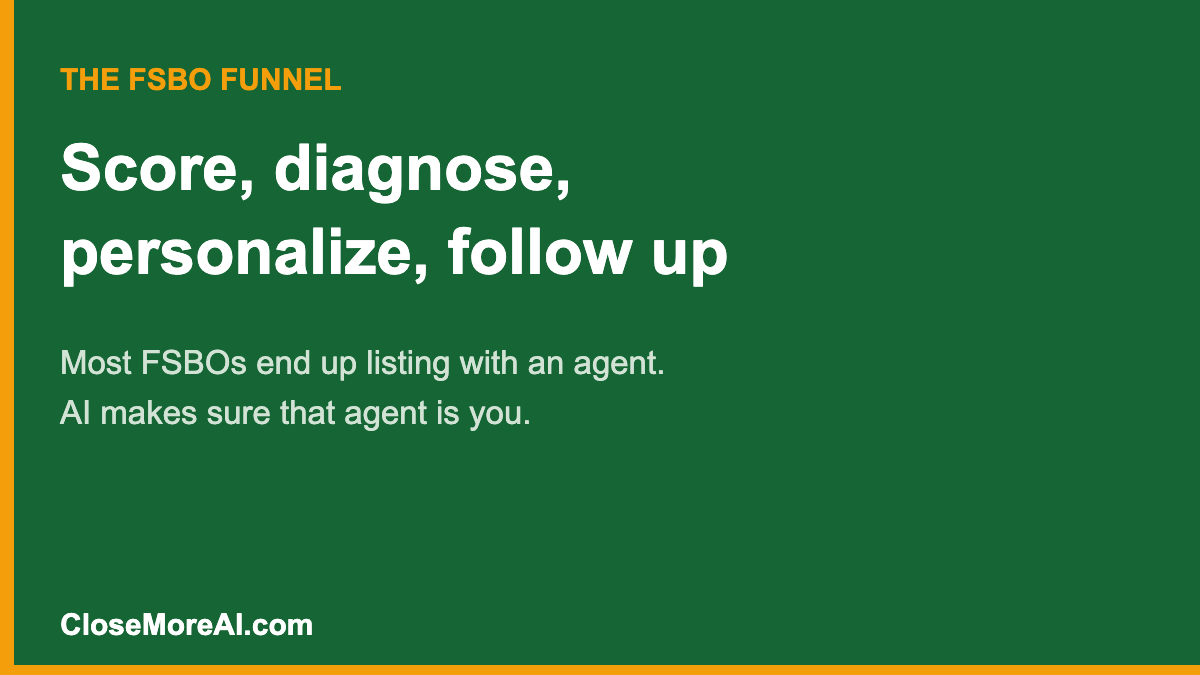
- Likelihood-to-convert scoring — predictive and prospecting platforms weigh equity, ownership length, price-vs-comps gap and days on market to rank which FSBOs are most likely to hand the listing to an agent soon, so you spend your hours on the top slice rather than the whole list.
- Diagnosis before outreach — AI can summarize a listing’s real problem in seconds: priced 6% over comps, dark photos, a thin description, the wrong platform mix. Your opener names the gap instead of pitching yourself.
- Personalized, value-first touches at scale — AI-drafted messages that reference the actual property (“your photos undersell the kitchen — here are three fixes”) instead of a canned script, sequenced across the 60–90 day fatigue window so the follow-up never depends on your memory.
The AI FSBO workflow, step by step
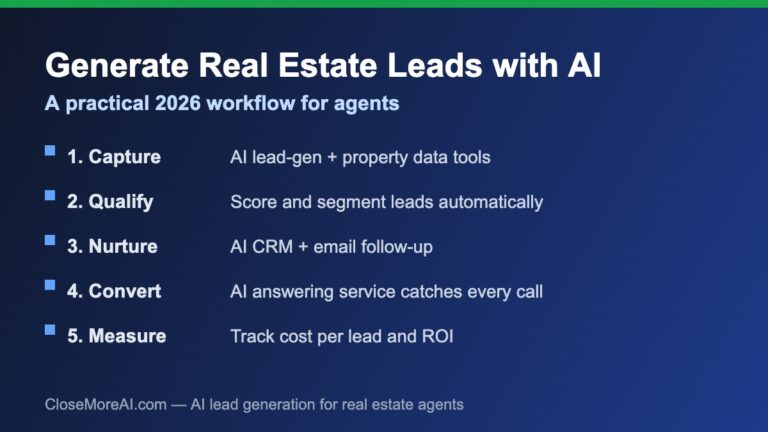
- Build today’s FSBO list and score it — pull active FSBOs in your farm from the sources above, dedupe them, and rank by the four winnability signals. Work the top slice first.
- Diagnose each stalling listing — have AI compare the asking price to recent comps, grade the photos, and time-stamp how long it’s sat. Your first contact should name the real problem, specifically.
- Lead with help, not a pitch — send a genuinely useful first touch: an updated equity and pricing analysis, staged photo suggestions, or a plain-English checklist of the paperwork and disclosures ahead. AI generates each in minutes; you review and sign off.
- Let the sequence run — schedule value-first touches across weeks two through twelve. The owner who says no in week one often calls back in week seven — but only if you’re still showing up with something useful.
- Escalate on engagement signals — opens, replies, and especially a price cut are your cue to call. A price reduction is FSBO fatigue in its purest form.
Run the same engine on sellers who haven’t listed yet — see our guide on how to use AI to predict when homeowners will sell — and on expired listings, the other warm listing-side source, to cover the full spectrum from one workflow.
Three outreach scripts that don’t sound like a pitch
The job of the first few touches is not to win the listing — it’s to earn a reply. Lead with a specific observation about their home, offer one useful thing, and make it effortless to say no. Fill the brackets from your diagnosis. Keep records of consent and opt-outs (see compliance below).
1. First-touch letter or mailer
Hi [Owner name], I saw your home at [address] is for sale by owner — it shows well, and [specific genuine compliment: the natural light in the living room is a real selling point]. One thing I noticed: [specific, fixable observation — comparable homes nearby are closing around $X, a bit under your current ask]. I put together a short, no-obligation pricing and net-proceeds snapshot for your property. Want me to drop it in your inbox? No pitch, no pressure — if selling on your own is working, keep going. [Name, license #, phone, email]
2. Voicemail (keep it under 20 seconds)
Hi [Owner name], this is [Name], a local agent — I’m calling about your for-sale-by-owner at [street]. I’m not calling to list it; I pulled the three most recent comparable sales on your block and thought you’d want the numbers whether you use an agent or not. I’ll text them over if that’s easier — just reply STOP if you’d rather I didn’t. Thanks, and good luck with the sale.
3. Email (CAN-SPAM compliant: real identity, physical address, clear opt-out)
Subject: Comps for [address] — no obligation
Hi [Owner name], you’re selling [address] on your own — respect that. I ran this week’s comparable sales within half a mile: [2–3 recent sales with price and date]. Based on those, your home is positioned [slightly high / right on market / under-priced], and here’s the one change I’d make first: [specific]. Full one-page analysis attached. If it’s useful, I’m happy to answer questions; if not, no worries at all. You can unsubscribe at the link below and I won’t email again. [Name, brokerage, license #, physical mailing address, unsubscribe link]
Compliance: calling, texting and emailing FSBOs legally
FSBOs advertise a number for buyer inquiries, which does not automatically mean you may cold-call or auto-text them as an agent. Treat compliance as part of the workflow, not an afterthought — the penalties are per-contact and add up fast. None of this is legal advice; confirm the current rules with your broker and counsel.
- National Do-Not-Call Registry & TCPA (calls). Many FSBO owners are on the National DNC Registry. Scrub your list before calling, keep an internal do-not-call list, and avoid autodialers and prerecorded/AI-voice messages to cell phones without prior express consent. Reputable FSBO lead services scrub against the DNC, but verify the scrub status yourself rather than assuming it.
- Texting. Marketing texts to a mobile number generally require prior express consent under the TCPA. One-to-one, manually typed texts are a grayer area, but platform-sent or templated blasts are clearly covered — get consent, honor STOP immediately, and keep a record.
- State “mini-TCPA” laws. Several states (for example Florida’s FTSA, plus Oklahoma and Washington) are stricter than federal rules on calls and texts, sometimes requiring express written consent. Check the rules for the state you prospect in.
- Email (CAN-SPAM). Identify yourself honestly, include a valid physical postal address, don’t use deceptive subject lines, and provide a working opt-out that you honor promptly.
- Fair housing. Target and word every touch around the property and the transaction — never around the owner’s or neighborhood’s protected characteristics (race, religion, national origin, familial status, disability, and the rest). “I work this ZIP code” is fine; anything that selects or excludes people by protected class is not.
- MLS, NAR and licensing rules. Be upfront that you’re a licensed agent on the first touch, don’t misrepresent yourself as a buyer, and follow your local MLS and state advertising rules on disclosures and license-number display.
What to look for in a tool
There is no single “FSBO app,” and you don’t need one — you need a small stack that covers four jobs. Pick the tools that do these well rather than whatever markets itself hardest:
- Lead data with phone numbers. FSBO-focused prospecting services such as REDX, Vulcan7 and Landvoice aggregate daily FSBO listings with contact details and usually DNC-scrubbing. They specialize in exactly this use case.
- A CRM that runs multi-week sequences. The whole FSBO game is persistence, so whatever CRM you already use must be able to schedule touches out to week twelve and remind you to call on engagement. See our roundup of the best AI CRM tools for real estate agents.
- An AI assistant for diagnosis and drafting. A general model (ChatGPT or Claude) is enough to summarize a listing’s pricing problem and draft the personalized touches — you supply the comps and review the output.
- Predictive scoring (optional). If you want the winnability ranking done for you, predictive seller-intelligence platforms fold equity, tenure and market signals into one score. Compare options in our best AI lead generation tools for real estate in 2026.
Whatever you choose, the tool is a multiplier on a sound process — it will not rescue a bad script or an inconsistent follow-up. Pair FSBOs with our guide to finding motivated sellers with AI for a complete listing-side pipeline.
Frequently asked questions
Is contacting FSBO sellers legal?
Yes, with the usual rules: scrub against the National Do-Not-Call Registry before cold calls, get consent for marketing texts, honor opt-outs immediately, follow CAN-SPAM on email, and check your MLS and state rules (several states are stricter than federal law). FSBOs advertising a phone number generally expect buyer calls — be upfront that you’re an agent and lead with value, not a bait-and-switch.
When is the best time to approach a FSBO?
Weeks three to eight is the sweet spot. Week one is pride; by week ten they’ve often already picked the agent who kept showing up. An AI sequence solves this by starting soft early and persisting automatically into the fatigue window, so you’re present at the moment the owner’s confidence cracks.
What makes a FSBO “winnable”?
Overpricing that explains the stall (fixable with strategy), healthy equity (they can afford to pay a commission once they see the net math), and visible fatigue signals — a price cut, reshot photos, or a relist. Scoring on those folds the judgment into one ranking so you spend time where the odds are best.
How many FSBO touches does it actually take to convert one?
There’s no magic number, but FSBO conversion is almost always a multi-touch, multi-week effort rather than a single call — which is exactly why a system that automates the follow-up beats sporadic manual outreach. Plan for a sequence spanning roughly weeks two through twelve, and let engagement signals (not a fixed count) tell you when to pick up the phone.
Can I use an AI voice assistant to call FSBOs?
Be very careful. Prerecorded and AI-generated voice messages to cell phones fall squarely under the TCPA and generally require prior express consent, and some states add their own rules. AI is far safer applied to the research and drafting side — scoring the list, diagnosing the listing, and writing personalized messages you review — than to automated dialing. When in doubt, dial manually and get consent before any automated contact.
Bottom line
Learning to win FSBO listings with AI turns the most avoided lead source in real estate into a system: find the active FSBOs, score them on equity, pricing and fatigue, diagnose the real stall, lead with help, and let automation carry the follow-up into the weeks where FSBOs actually convert — all while staying on the right side of DNC, TCPA and fair-housing rules. AI does the research and drafting; your judgment and consistency win the listing.
See how FSBOs fit your full stack in our complete guide to AI tools for real estate agents. And grab the free 2026 AI Toolkit for Real Estate Agents — the tools that win listings and close deals, in one shortlist.