How to Use AI to Predict When Homeowners Will Sell (2026 Agent’s Guide)
Updated September 2026.
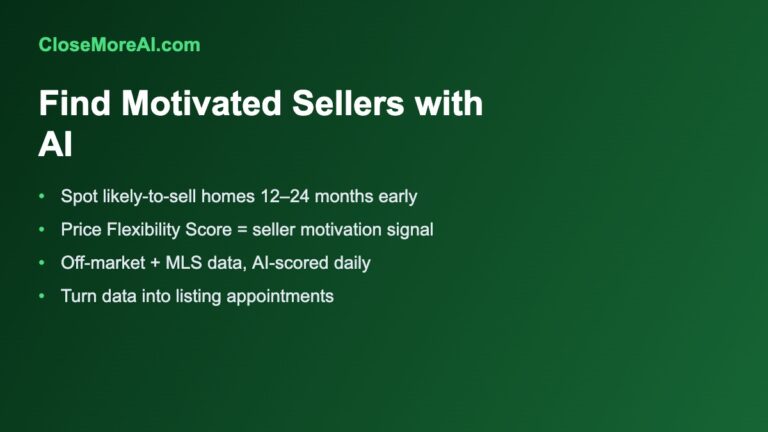
Every listing starts with one question: who’s going to sell next? Traditional prospecting — cold calls, mass mailers, door knocking — treats every homeowner the same. AI-powered prediction tools flip that logic entirely. They analyze data across millions of properties to identify the specific homeowners showing early signs they’re likely to sell — often six to twelve months before a listing hits the MLS. This guide explains how to use AI to predict when homeowners will sell, which signals matter, and how to turn those predictions into listings before a competitor even makes contact.
How AI predicts when homeowners will sell
AI seller prediction tools don’t read minds — they read patterns. Every homeowner who eventually sells leaves a data trail first: equity building past a useful threshold, a life event (new baby, divorce, job change, retirement), a change in local school district performance, or financial pressure from an adjustable mortgage resetting. The best platforms, like Homesage.ai, aggregate these signals across 150 million+ U.S. properties to surface the addresses most likely to transact in the next three to twelve months.
The result isn’t a magic number — it’s a ranked list. You get a segment of homeowners in your market sorted by likelihood to list, which lets you concentrate your phone time, mailers, and door knocks on the 5-10% of addresses with real intent instead of blanketing an entire ZIP code.
The signals AI actually tracks
Understanding what the algorithm weighs helps you interpret the output and spot false positives. Most platforms look at a combination of:
- Equity position — homeowners with 40%+ equity have a financial reason to sell; those underwater almost never do
- Length of ownership — the 5-to-8-year window historically produces the most listings in most markets
- Life-event triggers — marriage, divorce, birth records, probate filings, and job changes all correlate with near-term sales
- Behavioral signals — visits to listing sites, searches for moving companies, and recently sold comparables on the same block
- Market context — interest rate windows, local price appreciation, and seasonal inventory patterns that historically trigger move-up decisions
No single signal predicts a sale. The predictive score comes from how many signals overlap for a given property at a given time. That’s why AI’s edge over gut feel is significant: it processes thousands of data variables simultaneously, not just the two or three a human agent can track at once.
Step-by-step: using AI to find likely sellers
Here’s how a practical workflow looks once you’re set up with a predictive tool:
- Define your farm area — set the ZIP codes or neighborhoods you’re targeting. Most platforms let you filter by city, ZIP, or a custom boundary.
- Review your ranked list weekly — scores update as new data comes in. Check every Monday and flag the top 50-100 addresses for outreach.
- Layer in your CRM notes — if you’ve already spoken to someone on the list, note that context before reaching out again. Don’t cold-pitch a past open-house contact.
- Start the outreach sequence — the best tools automate the first touch with a personalized message. Follow up with a handwritten note or phone call for your top 10-20 highest-scoring addresses.
- Track your conversions — log which predicted sellers turned into actual listing conversations. This helps you calibrate trust in high-score vs. medium-score addresses over time.
A platform like Homesage.ai handles steps 1-4 in one place: it generates the ranked list, sends automated first-touch messages, and logs engagement — so your job is to follow up on the addresses that responded, not to babysit the initial outreach.
The best tool for predicting home sellers in 2026
Homesage.ai is the strongest option for agents who want a combined seller-prediction and follow-up platform. It doesn’t just tell you who might sell — it starts the conversation automatically using AI-driven texts and emails calibrated to feel personal rather than mass-blasted. Agents get a curated list of likely-to-list homeowners ranked by pre-listing signals, plus automated outreach that runs without manual input. For agents whose primary goal is finding sellers before competitors do, this is the most direct path from data to listing appointment.
Book a free Homesage.ai demo →
For a broader look at the category, see our breakdown of the best AI lead generation tools for real estate in 2026. To see how Homesage compares to alternatives, check our guide to finding motivated sellers with AI.
Turning predictions into listings
The prediction is only as valuable as what you do with it. Here’s what consistently converts predicted sellers into actual listing conversations:
- Be first, not loudest — a short, personal message (“I’ve been tracking your neighborhood and noticed your home may have built up significant equity — happy to share a quick market update if that’s useful”) outperforms generic postcards every time
- Multi-touch, multi-channel — most predicted sellers need 6-8 touches over 90 days before they respond; don’t give up after one attempt
- Lead with value before the ask — a free market analysis or neighborhood report gives them a reason to engage before they’re ready to list
- Time your escalation — if the score rises significantly in a two-week window, that’s a trigger to move from email to phone call
Being first matters more than anything: the National Association of Realtors consistently reports that the large majority of sellers interview only one agent before listing — whoever reaches them first usually wins. Pair this approach with AI-powered geographic farming to build a consistent pipeline of predicted sellers in your target neighborhood over time.
Outreach scripts that convert predicted sellers
A ranked list is worthless without a first touch that earns a reply. These templates work because they lead with a specific, local observation and a low-pressure offer — not a generic “are you thinking of selling?” pitch. Swap the bracketed fields for real details before you send.
Text / SMS (first touch):
“Hi [First name], this is [Your name] with [Brokerage] here in [Neighborhood]. A few homes near [Street] have sold well above list this quarter. I put together a quick, no-obligation estimate of what yours could bring today — want me to send it over?”
Email (value-first):
Subject: What homes on [Street] are selling for right now
“Hi [First name], I track the [Neighborhood] market closely and noticed a few recent sales that may have moved your home’s value. I’d be glad to send a free, no-strings market snapshot for [Address] — just reply ‘yes’ and I’ll get it to you this week. Either way, no pressure at all.”
Voicemail (after no reply to text/email):
“Hi [First name], [Your name] with [Brokerage]. I sent a note about recent sales near [Street] and wanted to make sure it reached you. If a current value estimate would be useful, I’m at [Phone]. No obligation — just here when you need it.”
Handwritten note (top 10–20 highest scores):
“[First name] — homes in [Neighborhood] are moving quickly and I’d love to share what that means for you whenever the timing’s right. — [Your name], [Phone]”
Tools like Homesage.ai can send a personalized first-touch text and email automatically, so these templates run across your whole ranked list while you reserve the calls and handwritten notes for the highest-scoring addresses.
A compliance note before you dial or text
Predictive lists make it easy to contact hundreds of homeowners fast — which is exactly why compliance matters here. Cold outreach to consumers is governed by the federal Telephone Consumer Protection Act (TCPA), the National Do Not Call (DNC) Registry, and a growing patchwork of state calling and texting laws. A few practical guardrails:
- Scrub against the DNC Registry. Calling or texting a number on the National Do Not Call Registry generally requires prior express consent or an established business relationship. Most reputable data providers offer DNC scrubbing — turn it on.
- Get consent before you text. Marketing texts to a cell number usually require prior express written consent. A homeowner appearing on a predictive list is not consent. When in doubt, call manually rather than mass-texting cold numbers.
- Avoid autodialers for cold contact. Automated or pre-recorded calls and texts to cell phones carry the highest TCPA exposure. Manual, one-at-a-time outreach is far safer for cold prospects.
- Honor opt-outs immediately. “Stop” means stop — remove the contact from every channel the moment they ask.
- Check your state’s rules. Several states have their own mini-TCPA and texting statutes that are stricter than federal law and carry their own penalties.
None of this is legal advice — TCPA penalties are steep and the rules change, so confirm your outreach process with your broker’s compliance team or a qualified attorney before you scale. The National Association of Realtors publishes member guidance on the DNC rules that is a useful starting point.
Frequently asked questions
How accurate are AI seller prediction tools?
The best platforms claim 40-70% of their high-score predictions list within 12 months — significantly better than random prospecting. Accuracy varies by market density and data quality. Dense suburban markets with lots of comparable sales produce more reliable scores than thin rural markets with fewer transaction signals.
Can I use AI seller prediction if I’m a new agent with no database?
Yes — platforms like Homesage.ai draw on their own national dataset, not yours. You don’t need to bring a large CRM to get value. Start with a small farm area (300-500 addresses), work the top 50 predictions consistently for 90 days, and measure your conversion rate before scaling up.
How does AI seller prediction compare to circle prospecting?
Circle prospecting is reactive — you call neighbors after a nearby home lists or sells. AI prediction is proactive — you identify likely sellers weeks or months before any listing activity in their area. They’re complementary: use prediction for long-cycle farming and circle prospecting as a short-cycle conversion trigger after a nearby sale.
Is it legal to cold-call or text a homeowner AI flagged as a likely seller?
Appearing on a predictive list is not consent to be contacted. Cold calls and texts are governed by the TCPA, the National Do Not Call Registry, and state-level rules. Scrub your list against the DNC Registry, get express consent before sending marketing texts, avoid autodialers for cold outreach, and honor opt-outs immediately. Because penalties are significant, confirm your process with your broker’s compliance team or an attorney — this isn’t legal advice.
Bottom line
Knowing how to use AI to predict when homeowners will sell gives you a systematic edge over agents who still cold-call expired lists or blast the same mailer to every door. The AI analyzes pre-listing signals you’d never catch manually, ranks your farm by likelihood to transact, and starts outreach automatically. For most listing-focused agents in 2026, Homesage.ai is the clearest path from predictive data to listing appointment. Review your ranked list weekly, work the top contacts consistently, and let the AI handle the first touch.
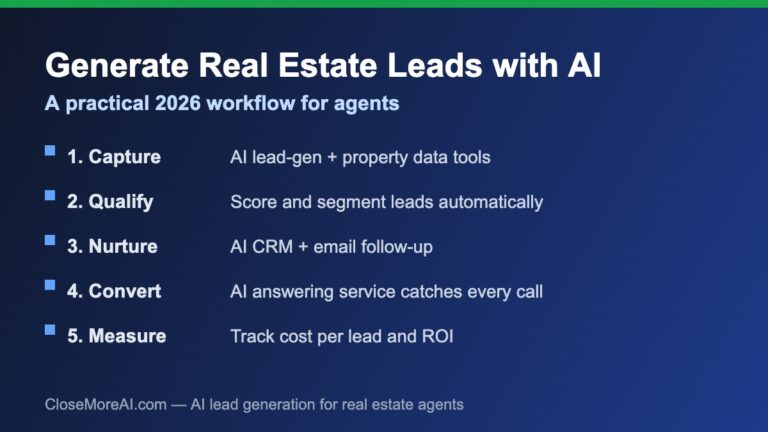
See how seller prediction fits the full picture in our complete guide to AI tools for real estate agents. Want to generate more inbound buyer leads too? See our guide to generating real estate leads with AI.
Want our full shortlist in one place? Grab the free 2026 AI Toolkit for Real Estate Agents — 25 tools that win listings and close deals.