How to Stage a Vacant House With AI: The 2026 Agent’s Guide
Empty rooms are the hardest sell in real estate. Without furniture, buyers struggle to visualize scale, function, or lifestyle — and vacant listings routinely sit on the market longer than furnished or staged ones. AI virtual staging for vacant houses solves this without the $2,000-plus cost of physical staging. This guide walks you through exactly how to stage a vacant house with AI in 2026, which platform gives the most realistic results, and how to produce listing-quality photos from a single upload.
Why vacant listings need staging
According to the Real Estate Staging Association, staged homes sell 73% faster than vacant, unstaged properties, and consistently command higher offers. Buyers touring an empty room focus on scuffs, ceiling height, and floor condition rather than potential. Staging redirects attention to what matters — lifestyle, scale, and warmth.
Physical staging requires renting furniture, hiring a professional stager, coordinating delivery, and paying monthly rental fees until closing. For a three-bedroom home, that typically runs $1,500-$3,000 upfront plus $500-$800 per month. AI virtual staging delivers the same visual impact in a few hours for $20-$50 per image — from any listing photo, with no furniture trucks required.
What AI virtual staging actually does
AI staging tools use generative image models trained on thousands of professionally staged rooms. You upload a photo of the empty room; the AI identifies walls, floors, windows, and architectural features; then it renders photorealistic furniture, rugs, art, and lighting that fit the space proportionally. Modern tools can produce a result in seconds and match multiple style presets — modern farmhouse, Scandinavian minimal, transitional, coastal, luxury — from a single photo.
The output is a rendered image you use in MLS photos, social ads, and listing brochures. A “virtually staged” caption in the MLS listing discloses the enhancement — standard practice, and most buyers now expect to see a mix of staged and actual photos in any listing.
How to stage a vacant house with AI: step by step
- Shoot clean, well-lit photos of every room — AI staging only performs as well as the input photo. Shoot in daylight, use a wide-angle lens at 3-4 feet off the floor, and remove any debris, boxes, or construction materials. Good lighting is the single biggest factor in result quality.
- Choose your AI staging platform — Collov AI is our top pick for vacant listings (more on why below). Upload directly from the web app — no software install required.
- Select the room type and design style — specify living room, primary bedroom, dining room, etc. Then choose a style preset. For most mainstream US listings, contemporary or transitional styles photograph best and appeal to the widest buyer pool.
- Review the render and regenerate if needed — the first result is usually strong, but you can regenerate for a different furniture layout or style variant. Most plans include 3-5 attempts per image.
- Export in high resolution — download at 2000px+ width, which is MLS-ready. Add a “virtually staged” caption to every AI-rendered photo as required by your MLS rules.
- Prioritize the three power rooms — focus your staging budget on the living room, primary bedroom, and kitchen/dining area. Buyers form their impression of a property from these three rooms; secondary bedrooms and bathrooms are lower priority.
Best AI tool for vacant listing staging in 2026
Collov AI is our top recommendation for agents staging vacant properties. It produces photorealistic results with accurate proportional rendering, offers a wide style library including luxury and mid-century modern presets, and handles architectural features — vaulted ceilings, bay windows, fireplace alcoves — better than most alternatives. The workflow is fast: upload, choose a style, download.
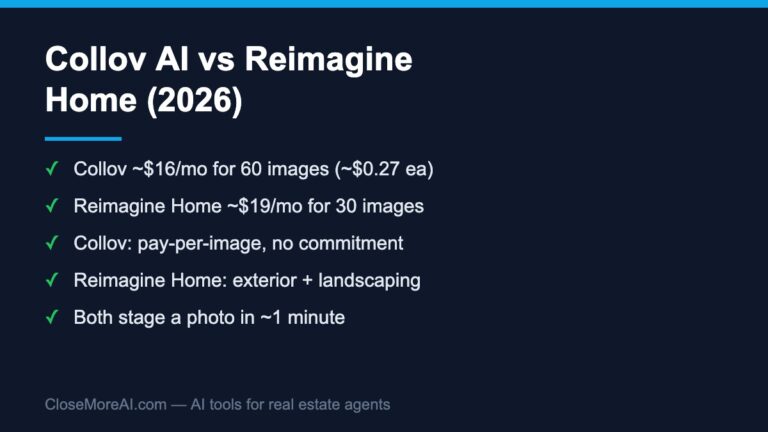
For agents handling multiple vacant listings per month, Collov’s subscription plans make the per-image cost dramatically lower than any physical staging option. The platform is also useful for showing renovation potential — you can digitally preview new flooring, paint colors, or cabinet finishes before a renovation begins; see our full guide to AI virtual renovation for real estate.
Try Collov AI for your next vacant listing →
For a broader comparison, see our roundup of the best AI virtual staging tools for real estate agents in 2026.
Tips for getting the most realistic AI staging results
- Shoot from corners, not walls — a corner perspective shows two walls and gives the AI more structural context, producing better furniture placement and more natural shadows
- Correct lens distortion before uploading — heavy wide-angle distortion throws off AI furniture scaling; a quick Lightroom correction improves render accuracy significantly
- Keep windows in the frame — natural light reference points help the AI render shadows and ambient lighting more realistically
- Match the style to your buyer demographic — a starter home in the suburbs converts better with clean contemporary furnishings than a maximalist luxury render; match staging style to the likely buyer
- Disclose every virtually staged image clearly — both MLS rules and NAR ethics require it; put “virtually staged” in every AI-rendered photo caption
Frequently asked questions
Do AI-staged photos actually help sell vacant homes faster?
Yes — staging industry data and agent case studies consistently show that virtually staged listings reduce days on market and improve offer quality vs. vacant listings. Buyers respond positively to high-quality AI staging because it helps them visualize living in the space. See our breakdown of whether virtual staging helps sell homes faster for detailed numbers and agent examples.
Can AI virtual staging work for luxury vacant listings?
Yes, but quality matters more at the luxury tier. Luxury buyers are more visually sophisticated, so renders that look artificial can work against you. Use a platform like Collov AI that offers dedicated luxury preset styles and renders at high resolution. For true ultra-luxury listings ($3M+), consider pairing AI staging with a small number of physically staged accent pieces rather than relying entirely on AI-rendered photos.
How much does AI virtual staging cost compared to physical staging?
AI virtual staging typically runs $20-$50 per image, with no setup fee, delivery cost, or monthly rental charge. Physical staging for a vacant three-bedroom property costs $1,500-$3,000 upfront plus $500-$800 per month. For most listings, AI staging delivers 80-90% of the visual benefit at roughly 5% of the cost. The main trade-off: buyers who tour in person will see an empty home, so for long-listed properties, a few key physical staging pieces may still be worth adding.
Does AI staging work for outdoor and exterior shots?
Some platforms support outdoor staging — patio furniture, landscaping enhancements, or pool area renders. Collov AI includes an outdoor staging mode. Results are generally less realistic than interior staging because AI models are trained more heavily on indoor photos. Use outdoor AI staging as a supplement to strong interior renders, not as a primary listing visual.
Bottom line
AI virtual staging for vacant listings is one of the clearest return-on-investment plays available to listing agents in 2026. The cost per image is a fraction of physical staging, the turnaround is hours instead of days, and the visual impact on buyers is measurable and documented. Collov AI is the strongest option for agents who want photorealistic results without a learning curve — upload your vacant listing photos, choose a style, and have listing-quality staged images the same afternoon.
For more on virtual staging strategy, see our guide on AI staging for occupied and cluttered homes — a different but equally common challenge. See how staging fits the full toolkit in our complete guide to AI tools for real estate agents.
Want our full shortlist in one place? Grab the free 2026 AI Toolkit for Real Estate Agents — 25 tools that win listings and close deals.