AI ISA for Real Estate (2026): How an AI Inside Sales Agent Calls, Texts, and Qualifies Your Leads
An AI ISA for real estate — an AI-powered inside sales agent — is the tireless teammate most agents wish they could afford: it calls a new lead within seconds, texts the ones who don’t pick up, asks the qualifying questions you’d ask, books the appointment on your calendar, and keeps nurturing the slow-burn leads for months so nothing leaks out of your pipeline. It is not the same thing as an AI receptionist that answers your inbound phone; an AI ISA reaches out. This guide explains exactly what an AI ISA does, how it differs from a human ISA and an answering service, how to set one up, what it costs, and the two compliance rules — one of them brand new for AI voices — that you cannot skip.
In this guide:
- What is an AI ISA?
- Why speed-to-lead is the whole game
- What an AI ISA actually does
- AI ISA vs. AI receptionist vs. a human ISA
- How to set up an AI ISA, step by step
- The compliance you can’t skip: TCPA and Fair Housing
- What it costs and the ROI math
- Mistakes to avoid
- FAQs
What is an AI ISA?
In real estate, an inside sales agent (ISA) is the person whose entire job is the top of the funnel: dialing new leads fast, following up relentlessly, qualifying who is real and who is not, and setting appointments for the agents who close. It is one of the highest-leverage roles in a team — and one of the hardest to staff, because good ISAs are expensive, hard to keep, and can only work so many hours.
An AI ISA does that same top-of-funnel work with software. Fed a new lead, it places a natural-sounding call and sends a text in seconds, holds a real back-and-forth conversation, asks your qualifying questions (timeline, budget, financing, motivation, are they already working with an agent), and then either books the appointment or routes a warm, qualified lead to you with the context attached. The best ones run around the clock, handle hundreds of leads at once, and never forget to follow up on day 3, day 14, or month 6.
Why speed-to-lead is the whole game
The reason AI ISAs work is boring and well-documented: speed. The classic Lead Response Management Study (based on MIT research) found that leads contacted within the first five minutes are dramatically more likely to be reached and qualified than leads contacted even 30 minutes later — and the odds fall off a cliff after the first hour. Online buyers and sellers inquire on several sites at once; the agent who responds first usually wins the conversation.
No human ISA, however good, calls every lead inside five minutes at 9pm on a Sunday. Software does. That single capability — instant, consistent first contact — is why an AI ISA can lift the conversion rate of leads you are already paying for, without spending another dollar on ads. It is the same logic behind our guide on how to generate real estate leads with AI: the cheapest deal is the one hiding in leads you already have.
What an AI ISA actually does
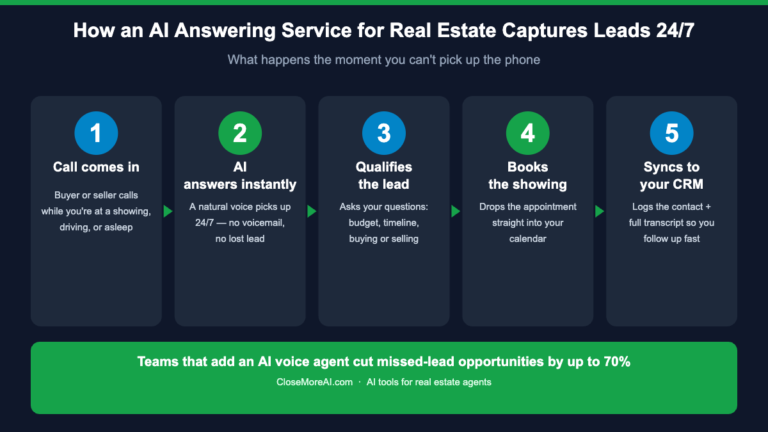
It helps to be concrete about the jobs an AI ISA handles, because “AI” can sound like magic when it is really five specific tasks done fast and consistently:
- Instant first contact. The moment a lead comes in from a portal, your site, or an ad, the AI ISA calls and texts — in seconds, day or night.
- Qualifying conversation. It asks your questions — are you looking to buy or sell, what’s your timeline, price range, are you pre-approved, are you working with another agent — and listens to the answers.
- Appointment setting. When a lead is ready, it books the call or showing directly on your calendar instead of playing phone tag.
- Long-term nurture. The 90%+ of leads who aren’t ready today get automated, human-sounding follow-up over weeks and months, so they think of you when they finally move.
- Warm hand-off. Qualified leads are routed to you with a summary of the conversation, so you step in already knowing the situation.
What an AI ISA does not do is replace you. It does the repetitive dialing and filtering so your human time goes to the conversations that actually close. Think of it as the layer that feeds your CRM — pair it with one of the best AI CRM tools for real estate agents and the qualified leads land in a system that tells you who to call next.
AI ISA vs. AI receptionist vs. a human ISA
These three get conflated constantly, and choosing the wrong one wastes money. The key difference is direction and cost:
| AI ISA | AI receptionist | Human ISA | |
|---|---|---|---|
| Direction | Outbound — calls & texts your leads | Inbound — answers calls that come to you | Outbound (and inbound) |
| Main job | Qualify leads & set appointments | Catch calls, take messages, book | Qualify leads & set appointments |
| Availability | 24/7, hundreds at once | 24/7 | Set hours, one call at a time |
| Typical cost | Low monthly SaaS fee | Low monthly SaaS fee | Salary + commission |
| Best for | Turning paid leads into booked appointments fast | Never missing an inbound caller | Nuanced, high-touch qualification at scale |
If your problem is missed inbound calls, you want the receptionist side — see our guide to the best AI answering services for real estate agents and our breakdown of an AI receptionist’s cost and ROI. If your problem is leads going cold before you can call them back, you want an AI ISA. Many teams run both.
How to set up an AI ISA, step by step
- Connect your lead sources. Point your portal leads, website forms, and ad lead-forms at the AI ISA so it fires the instant a lead arrives. Speed only works if the trigger is immediate.
- Write your qualifying script. Decide the five or six questions that separate a real lead from a tire-kicker for your market, and load them in. Keep it conversational, not an interrogation.
- Define the hand-off rule. Tell the system what “qualified” means for you (e.g., moving in 90 days, pre-approved, not already under contract with an agent) and where those leads go — your calendar, your phone, your CRM.
- Build the nurture track. Set the long-term follow-up cadence for leads who aren’t ready, so no one is dropped after one attempt. This is where an AI email marketing system pairs naturally with call-and-text follow-up.
- Get consent handling right. Before you turn on outbound AI calling, set up how you capture and record consent (see the compliance section below). This is not optional.
- Review transcripts weekly. Read what the AI said and how leads responded, then tune the script. Treat it like coaching a new hire for the first month.
The compliance you can’t skip: TCPA and Fair Housing
Automating outbound calls automates your legal exposure too. Two rules matter, and one of them changed specifically because of AI.
TCPA and AI voices. In February 2024 the FCC ruled that calls using AI-generated or cloned human voices are “artificial” under the Telephone Consumer Protection Act — which means they require the recipient’s prior express consent, and prior express written consent for marketing calls (FCC: TCPA applies to AI technologies that generate human voices). In plain terms: you generally cannot point an AI voice dialer at a cold list. You need leads who opted in to be contacted, honor Do-Not-Call and opt-out requests, and mind calling-hour rules. Reputable AI ISA platforms build consent capture and opt-out handling in — but the liability is yours, so confirm it before you dial.
Fair Housing. The same rule that governs your listings governs your scripts: talk about the property and the process, never the type of person who “should” live somewhere. The Fair Housing Act prohibits statements indicating a preference or limitation based on protected classes (NAR: The Fair Housing Act). An AI reading a script will say whatever you loaded, so keep protected-class language out of the qualifying questions and the follow-up entirely.
What it costs and the ROI math
The appeal of an AI ISA is the cost gap. A human ISA is a salary plus commission plus training and turnover; an AI ISA is typically a monthly software fee that is a small fraction of that, with no ceiling on how many leads it works at once. You do not need a big win for it to pay off: if you already spend on portal or ad leads, lifting even a few percent of them from “never answered” to “booked appointment” — purely by contacting them in seconds instead of hours — usually covers the subscription many times over. The honest caveat is that an AI ISA multiplies whatever lead flow you feed it; it will not manufacture leads out of nothing, and a bad script produces bad conversations at scale. Get the inputs right and it is one of the highest-ROI hires you’ll never put on payroll.
Mistakes to avoid
- Pointing it at a cold, non-consented list. The fastest way to a TCPA problem. Only call leads who opted in, and honor every opt-out.
- A robotic, over-long script. If it feels like an interrogation, leads hang up. Keep it warm, short, and human.
- No hand-off plan. If a hot, qualified lead has nowhere to go, the speed advantage is wasted. Wire the calendar and CRM before launch.
- Set-and-forget. Read transcripts and refine for the first few weeks. An untuned AI ISA underperforms a tuned one badly.
- Skipping Fair Housing review. Whatever you script, the AI will say — at scale. Keep protected-class language out.
FAQs
What is the difference between an AI ISA and an AI receptionist?
An AI ISA works outbound — it calls and texts your leads to qualify them and set appointments. An AI receptionist works inbound — it answers calls that come to you so none go to voicemail. Many teams use both: the ISA chases leads, the receptionist catches callers.
Is it legal to use an AI voice to call real estate leads?
Yes, within the rules. Since the FCC’s 2024 ruling, AI-generated voice calls are treated as “artificial” under the TCPA and require the recipient’s prior express (and, for marketing, written) consent. So you can call leads who opted in, but you cannot AI-dial a cold list, and you must honor Do-Not-Call and opt-out requests.
Will an AI ISA replace my human ISA or my job?
No. An AI ISA handles the repetitive instant-dialing, qualifying, and endless follow-up. It hands warm, qualified leads to a human to build the relationship and close. It expands what a solo agent or small team can cover; it doesn’t replace the closing conversation.
How fast can an AI ISA respond to a new lead?
Seconds — that’s the entire point. It fires the moment a lead hits your connected sources, which is what puts you inside the critical first-five-minutes window that research links to far higher qualification rates.
Bottom line
An AI ISA for real estate is the outbound counterpart to an AI receptionist: it attacks the speed-to-lead problem by calling and texting every new lead in seconds, qualifying them, booking appointments, and nurturing the rest for months — at software prices. Get three things right and it compounds: immediate lead triggers, a warm and compliant script, and a clean hand-off into your pipeline. Just clear the TCPA consent bar before you dial and keep Fair Housing language out of every script. Ready to build the rest of the stack? Feed qualified leads into one of the best AI CRM tools for real estate agents, never miss an inbound caller with the best AI answering services, and see how it all fits together in our complete guide to AI tools for real estate agents. And grab the free 2026 AI Toolkit for Real Estate Agents — the tools that win listings and close deals, in one shortlist.
Related guides
- Best AI answering services for real estate agents — the inbound counterpart that catches every caller.
- Best AI CRM tools for real estate agents — where your qualified leads land and get prioritized.
- How to generate real estate leads with AI — fill the top of the funnel your AI ISA works.