How to Find Divorce Real Estate Leads With AI in 2026: The Agent’s Playbook
Divorce real estate leads are among the most reliable listing sources an agent can build in 2026, for one blunt reason: when a marriage ends, the house almost always has to be sold or bought out. The sale isn’t optional, the timeline is often court-driven, and the two owners rarely share an agent relationship going forward. AI has made this niche far more workable by handling the finding and prioritizing, so the agent can focus on the part that actually wins the listing: tact. This playbook shows you how to build a respectful, AI-assisted divorce-listing pipeline in five steps.
Updated October 2026.
In this guide:
- Why divorce real estate leads convert
- How AI finds and prioritizes them
- Where the data actually comes from
- The 5-step AI workflow
- Outreach that respects the situation
- Outreach scripts you can copy
- Compliance: fair housing, TCPA, DNC & CAN-SPAM
- Mistakes to avoid
- FAQs

Why divorce real estate leads convert so well
A divorce almost guarantees a transaction. The marital home is usually the largest shared asset, and dividing it typically means one spouse buys the other out or the property is sold and the proceeds split. Either way, someone needs a valuation, a listing, or a purchase — often on a deadline set by the court or the settlement. Competition is also thinner than in most listing niches, because many agents feel awkward about the topic and stay away. The National Association of Realtors consistently finds that most sellers hire the first credible agent who reaches them (NAR research & statistics), and in a divorce the parties frequently need a neutral professional neither spouse chose — a role you can fill if you show up early and handle it with care.
How AI finds and prioritizes divorce real estate leads
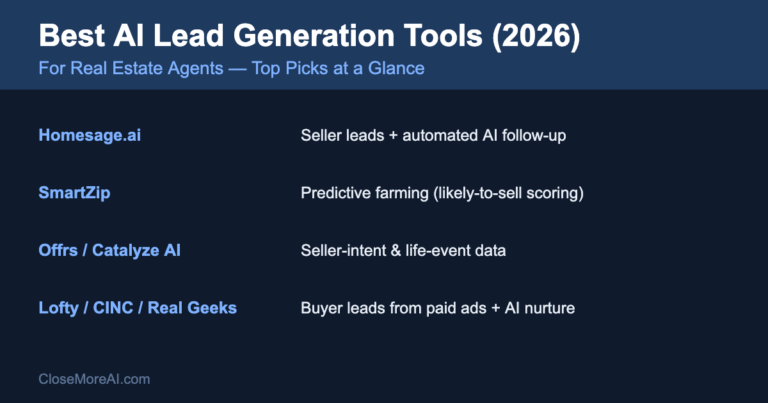
Divorce filings are public records at the county level, but reading them by hand and matching each case to a property is slow, uncomfortable work. AI collapses it. Predictive-seller platforms analyze hundreds of millions of property records and layer ownership and life-event signals — joint ownership, recent title changes, mailing-address changes, and other patterns that correlate with a household in transition — then rank properties by likelihood of a near-term sale. Instead of combing court dockets by hand, you get a prioritized shortlist of homes where a sale is probably coming. Compare the options in our guide to the best AI lead generation tools for real estate, and pick whichever fits your county and budget — the workflow below works with any of them.
Where the data actually comes from
You don’t need a paid platform to start. Every signal below is a public record — a predictive tool mainly saves you the hours of pulling and cross-matching. Here is where each signal lives and what it tells you.
| Signal | Where it lives | What it tells you | How to pull it |
|---|---|---|---|
| Divorce / dissolution filing | County Clerk of Court (family-law or domestic-relations division); many counties have an online case-search portal | A marriage is legally ending, so the marital home will likely be sold or bought out | Search the public case index by case type (dissolution of marriage); copies of documents may cost per page |
| Lis pendens / notice of action | County Recorder / Register of Deeds | A pending action may be attached to the property and can cloud title | Search the recorder index by owner name or parcel number |
| Vesting deed & open mortgages | County Recorder / Register of Deeds | Confirms joint ownership (both spouses on title) and the rough equity position | Pull the most recent deed plus any recorded mortgages or liens |
| Assessment & tax record | County Assessor / Tax Collector | Assessed value, homestead or owner-occupancy status, and who is paying the taxes | Assessor parcel search by address or owner name |
| Mailing-address change | USPS NCOA, via a licensed data vendor | One spouse has moved out — a strong signal a sale is coming | Available only through a USPS-licensed processor, never pulled directly |
| Attorney & mediator network | State and local family-law bar directories; local mediators | Warm referrals — not a record, but the highest-converting source in this niche | Build relationships over time (see the scripts below) |
Two practical notes. First, access rules vary by state: some courts publish the full divorce docket online, while others seal financial affidavits or restrict access to the parties and their attorneys — check your county’s rules and never try to work around a sealed record. Second, a filing is a starting point, not a green light: confirm the property is jointly owned and still occupied before you spend time on it.
The 5-step AI workflow for divorce leads
- Pick your county and price band. Like probate and pre-foreclosure, divorce is a county-level game — filings live at the courthouse, so focus where you want listings.
- Combine public filings with AI ownership data. Cross-reference divorce filings (many counties publish them) with your AI platform’s ownership signals to flag jointly-owned homes tied to a case.
- Let the AI rank by sell-probability. This turns a docket into a pipeline — see how AI predicts when homeowners will sell for what the scoring signals mean.
- Tag by situation in your CRM. Note whether it’s a likely buyout, a sale, occupied by one spouse, or vacant — so your outreach is specific and never generic.
- Work the list patiently. Divorce timelines stretch over months; the case that’s too raw in July is often ready to list by autumn. Rankings refresh as signals change.
Outreach that respects the situation
This is the niche where tone decides everything. A divorcing homeowner remembers the agent who was crass. Lead with neutrality and service, never urgency. What works: a brief, judgment-free letter offering a free, no-obligation valuation and a clear explanation of the options (sell and split, or one spouse buys the other out), positioning yourself as a neutral professional who can work with both parties or their attorneys. Follow up gently, and be comfortable coordinating with divorce attorneys and mediators — they refer listings repeatedly once they trust you. Divorce leads also overlap with the other pools you should already be working; cross-reference with our playbooks for absentee owner leads and probate real estate leads, since life-transition properties often surface in more than one list.
Outreach scripts you can copy
Keep every touch short, neutral, and service-first. You are offering clarity and options, not chasing a distressed sale. Adapt the names and details, and always give the owner an easy way to opt out.
1. Letter or handwritten note
Dear [First name],
My name is [Your name], a local real estate broker with [Brokerage]. I work with homeowners weighing what to do with a property during a life change, and I help both parties understand their options without pressure — whether that is selling and splitting the proceeds or one owner buying the other out. If a no-obligation valuation would be useful to you (or to your attorney), I am glad to provide one. You can reach me anytime at [phone] or [email]. If you would prefer not to hear from me, just let me know and I will not reach out again.
2. Voicemail (only if the number is not on the DNC registry)
Hi [First name], this is [Your name] with [Brokerage] here in [city]. I help homeowners work through their options for a property during a transition, and I keep it neutral and low-key. If a free valuation or a quick conversation about options would help, call or text me at [phone]. No pressure either way — take care.
3. Email
Subject: A neutral valuation, whenever you need it
Hi [First name],
I am a local broker who helps homeowners understand their options for a property during a life change — selling and dividing the proceeds, or one owner buying the other out. If it would help you or your attorney, I can prepare a free, no-obligation valuation and walk through the choices at whatever pace works. Reply here or call me at [phone]. If you would rather not receive anything further, reply STOP and I will remove you right away.
— [Your name], [Brokerage], [license #], [mailing address]
Compliance: fair housing, TCPA, DNC & CAN-SPAM
This niche is sensitive, and the rules are not optional. Nothing here is legal advice — confirm specifics with your broker and your own counsel — but these are the guardrails every agent should keep in view.
- Fair housing. The federal Fair Housing Act protects familial status, and many state and local laws also protect marital status. Market your service, not an assumption about someone’s situation; treat both parties equally, never steer, and never imply one spouse should act against the other.
- TCPA and Do-Not-Call. Scrub every phone number against the national and your state DNC registries before you call or text, keep calls within permitted hours (generally 8 a.m.–9 p.m. in the recipient’s local time), and get express written consent before any autodialed or pre-recorded call or text. Manual, personal calls to non-DNC numbers are the safest path.
- CAN-SPAM. Every marketing email needs a truthful subject line, a real physical mailing address, and a working opt-out that you honor promptly.
- Sealed and confidential records. Some states restrict divorce financial affidavits or seal parts of the file. Use only what is lawfully public, and never reference private details of the case in your outreach — it is both a compliance risk and the fastest way to lose the relationship.
Mistakes to avoid
- Picking a side. The moment you look like one spouse’s agent, you lose the other — and often the listing. Stay neutral.
- Using distressed-seller scripts. Divorcing owners aren’t foreclosure “motivated sellers”; treat it as the sensitive life event it is. For that separate pipeline, use our guide to finding motivated sellers with AI.
- Rushing the timeline. Settlements move on legal schedules. Pressuring before the parties are ready burns the relationship.
- Mailing everyone equally. Volume without AI ranking is slow and tone-deaf. Rank first, reach out selectively.
FAQs
Are divorce real estate leads legal to contact?
Yes — divorce filings and property records are public records. Follow the usual rules: honor Do-Not-Call for phone outreach, include opt-outs in mail and email, and be especially mindful of tone given the circumstances.
Should I work with divorce attorneys?
Absolutely — building referral relationships with family-law attorneys and mediators is the highest-leverage move in this niche. They send repeat business once they trust you to handle clients with discretion.
What’s the best AI tool for divorce leads?
There’s no single “best” tool — what matters is whether a platform can rank jointly-owned homes by sell-probability and layer in life-event signals from public records. Shortlist two or three, run a free trial on your own county, and compare the quality of the ranked list. Our guide to the best AI lead generation tools for real estate walks through the main options and what each is good at.
How do I find divorce filings in my county?
Start at your county Clerk of Court website and look for a public case-search or docket portal, then filter by case type (dissolution of marriage or domestic relations). Where records are not online, the clerk’s office can usually be searched in person. Cross-reference the names against the county recorder and assessor to confirm the property is jointly owned before you reach out.
Isn’t it insensitive to prospect divorce leads?
It can be, if you do it badly. Done right — neutral tone, a genuine offer of help, no pressure, and full respect for both parties — you are providing a service people in this situation actually need: a professional neither spouse has to feel was chosen against them. The agents who win here lead with care, not urgency.
Bottom line
Divorce real estate leads reward the agent who is early, neutral, and kind — and AI now does the finding and ranking that used to mean uncomfortable hours in court records. Start with a ranked list, lead with service, build attorney relationships, and work each file on its own timeline. See how it fits the rest of your stack in our complete guide to AI tools for real estate agents, and grab the free 2026 AI Toolkit for Real Estate Agents — 25 tools that win listings and close deals, in one shortlist.