How to Find Motivated Sellers with AI (2026): A Practical Guide for Agents
Every listing starts with one thing: a seller who is ready to move. The fastest-growing agents in 2026 don’t wait for those sellers to call — they find motivated sellers with AI before the competition even knows the home is in play. This guide shows the 7 data signals that predict who will list, how AI seller-scoring tools rank them, and a 30-minute weekly workflow that turns that data into listing appointments.
Updated September 2026.
See motivated-seller scoring for your market — free Homesage AI demo →
Table of contents
- What “motivated seller” really means in data
- The 7 seller-motivation signals that matter
- How AI predicts who will sell
- Best AI seller-scoring tools compared
- Using Homesage AI to surface seller leads
- Finding off-market seller leads before they list
- A 30-minute weekly workflow
- Where to pull each motivation signal
- A first-touch script that gets replies
- FAQ
What a “motivated seller” really means in data
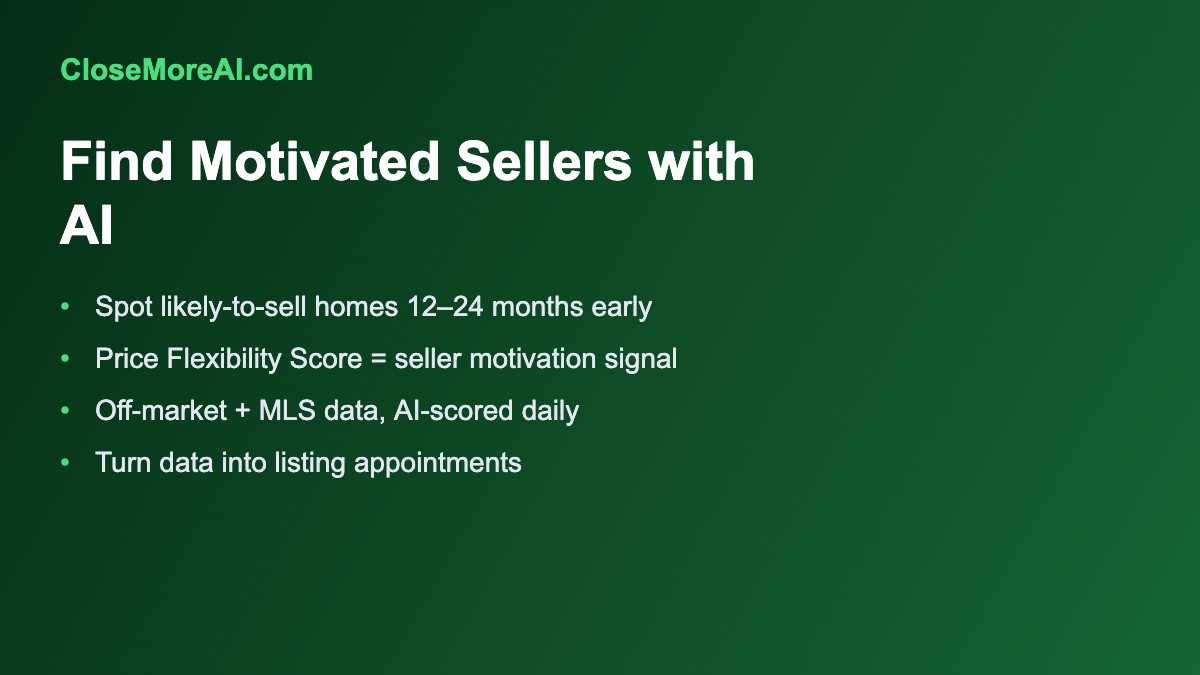
A motivated seller is a homeowner with both a reason to move and flexibility on price or timing. Traditionally agents guessed at this from farming, door-knocking, and life-event lists. AI changes the game by scoring millions of properties on the signals that actually correlate with selling — equity position, length of ownership, off-market activity, and price flexibility — so you can prioritize the handful of homeowners most likely to list in the next 12–24 months.
The 7 seller-motivation signals that matter
Not all data is equally predictive. These are the seven signals AI scoring models weight most heavily — and that you should look for even when reading a report manually:
- Equity position. Owners with substantial equity can afford to sell and move; underwater owners rarely list voluntarily. High equity plus an older loan is the single strongest “can sell” signal.
- Length of ownership. In most US markets the typical owner sells after roughly 8–13 years. Owners past that band, especially in appreciated neighborhoods, are statistically overdue.
- Life-event indicators. Divorce filings, probate cases, and empty-nest downsizing are the classic listing triggers — we cover each playbook in depth: divorce leads, probate leads, and downsizing sellers.
- Absentee or landlord status. Owners who don’t live in the property sell more readily — no emotional attachment, and lease turnover creates natural exit windows. See absentee owner leads.
- Financial distress markers. Pre-foreclosure filings, liens, and delinquency signal urgency — handle with care and lead with help, not a pitch (full guide: pre-foreclosure leads).
- Price flexibility. AI models can estimate how much negotiating room a seller likely has from equity, time-on-market history, and local comps — the closest thing to a direct “motivation” readout.
- Neighborhood turnover velocity. When several nearby homes sell quickly at strong prices, on-the-fence owners are far more likely to act. Models track this block-by-block; humans usually notice too late.
How AI predicts who will sell
Modern platforms analyze MLS, off-market, and for-sale-by-owner data with computer vision and neural networks to forecast property values and seller behavior. Instead of a static mailing list, you get a daily-updated, ranked view of which homeowners show motivation signals right now. The best systems even estimate how much room a seller may have on price, so your outreach and your offers are grounded in data rather than hope.
Best AI seller-scoring tools compared
Several platforms score seller motivation, and they take genuinely different approaches. Here’s the honest comparison for a working agent in 2026:
| Tool | What it scores | Pricing model | Best for |
|---|---|---|---|
| Homesage AI | Price Flexibility Score + AI value/ARV on 150M+ properties, updated daily | Demo-first, plan-based | Agents who want motivation and pricing context in one report |
| Likely.ai | Likelihood-to-sell percentage on your contact list/farm | Subscription per contact volume | Scoring an existing database |
| Offrs | Territory-based seller predictions (Smart Data) | Monthly per ZIP territory | Agents farming a specific ZIP |
| SmartZip | Predictive scores + built-in marketing automation | Higher-cost bundled subscription | Teams that want scoring + done-for-you marketing |
Our pick: for a solo listing agent, Homesage AI is the strongest starting point because the Price Flexibility Score answers both questions that matter — who might sell and how much room there is — while territory tools like Offrs make sense once you commit to farming one ZIP long-term. Full head-to-heads: Homesage vs Likely.ai, Homesage vs Offrs, and Homesage vs SmartZip.
Using Homesage AI to find motivated sellers with AI
Homesage AI analyzes 150 million-plus residential properties and surfaces investment- and listing-ready opportunities daily. Its full property reports include AI-estimated value, ARV, automated comps, rental projections, and — most useful for prospecting — a Price Flexibility Score that estimates seller motivation and how much room there may be on price. For an agent, that score is a shortlist: it tells you which doors to knock and which calls to make first.
Book a free Homesage AI demo →
| Signal | What it tells you | In Homesage AI |
|---|---|---|
| Price Flexibility Score | Seller motivation / negotiation room | Yes |
| Equity & ownership length | Ability and likelihood to move | Yes |
| Off-market signals | Homes not yet listed | Yes |
| AI value & ARV | Pricing and upside context | Yes |
Finding off-market seller leads before they list
The highest-value motivated sellers are the ones who haven’t listed yet — no competition, no bidding war for the listing agreement. Off-market seller leads come from combining the signals above: an absentee owner with 15 years of equity in a fast-turnover neighborhood is an off-market lead even though nothing public says “for sale.” AI platforms surface these combinations automatically; your job is the human step — a credible, local, non-pushy first touch. Lead with a real number (“homes like yours on Maple sold for X last quarter”) rather than a generic “thinking of selling?” postcard, because specificity is what earns the reply.
A 30-minute weekly workflow
You don’t need a data-science degree to use this. A practical weekly routine looks like: (1) Monday, pull the top 20 scored properties for your farm area — not 200; depth beats volume. (2) Rank them by Price Flexibility Score and cut the list to the 10 best. (3) Send each a tailored note or make a call referencing real, current value data for their street — expect most touches to go unanswered; the goal is 1–2 real conversations per week. (4) Log every touch in your CRM and re-touch non-responders monthly — seller decisions play out over quarters, and consistency is what converts a scored lead into a listing appointment 3–6 months later. Pair this with a solid CRM so nothing slips — see our guides to the best AI CRMs and the best AI CRM tools for follow-up automation.
Seller leads are the lifeblood of the business — the National Association of Realtors consistently reports that most sellers choose an agent who reaches them first with credibility, which is exactly the edge data-driven prospecting gives you.
Where to pull each motivation signal (data sources agents actually use)
AI scoring tools bundle most of these signals for you, but knowing the underlying source keeps you honest about the data and gives you a free fallback when you want to verify a single lead by hand:
| Signal | Primary data source | Free or paid |
|---|---|---|
| Equity & ownership length | County assessor & recorder — deed and mortgage records | Free (public records) |
| Absentee / landlord status | Tax mailing address ≠ property address on the assessor roll | Free |
| Pre-foreclosure / distress | County lis pendens & notice-of-default filings; tax-delinquency lists | Free (some counties charge a copy fee) |
| Probate | County probate / surrogate court dockets | Free |
| Neighborhood turnover | MLS sold data / your brokerage back office | Included with MLS access |
| Price flexibility & value | An AI AVM (Homesage AI and similar) layered on live comps | Paid |
The practical takeaway: the raw signals are mostly public, but stitching them together across millions of parcels by hand is the part no working agent has time for — which is exactly what an AI seller-scoring layer automates.
A first-touch script that gets replies
Data gets you the name; the message gets you the appointment. Keep the first touch short, specific and local. A template that adapts to a call, a text or a handwritten note:
“Hi [First name], I’m [Your name] with [Brokerage] here in [Neighborhood]. A home similar to yours on [Street] just sold for [$X] — I put together a quick, no-obligation estimate of what yours could bring in today’s market. Want me to send it over?”
Notice what it does: it leads with a real number for their street, offers value (the estimate) instead of asking for the listing, and gives an easy yes/no. Send it, then follow the workflow above — re-touch non-responders monthly with a fresh comp rather than a repeat of the same message.
Compliance basics (this is general information, not legal advice). Before you call or text, scrub numbers against the federal and applicable state Do-Not-Call registries. The TCPA restricts telemarketing calls and texts to 8 a.m.–9 p.m. in the recipient’s time zone and generally requires prior express consent for autodialed or pre-recorded messages — manual, one-to-one texts to a genuine prospect are lower risk but still governed by state law. For email, CAN-SPAM requires a real physical mailing address and a working unsubscribe link. When in doubt, keep outreach manual and consent-based, and confirm your own state’s rules with your broker or counsel.
How AI calculates an offer range for a motivated seller
Once AI flags a likely seller, the next question agents ask is what should I actually offer? AI seller-scoring tools don’t invent a number — they build an offer range from three stacked inputs:
- Recent comparable sales (comps). The model pulls the last 3–6 arm’s-length sales of similar beds, baths and square-footage within roughly a half-mile and the last 90–180 days, then weights each comp by how closely it matches.
- Condition & property-detail adjustments. Deferred maintenance, a dated interior, a failing roof or a tired-landlord situation each shave a fairly predictable percentage off the comp-based value. Homesage’s Full Property Report, for instance, factors condition signals into its estimate instead of assuming turnkey.
- Motivation-weighted urgency. The higher the motivation score (pre-foreclosure, probate, tax delinquency, long-time absentee owner), the wider the discount a seller will statistically accept in exchange for speed and certainty — so the model widens the low end of the range.
You get a band rather than a single figure. A $310k–$340k retail comp value might surface as a $255k–$285k likely-accept range for a high-motivation owner, and you anchor your first offer near the bottom with room to negotiate up. Treat that number as a hypothesis to validate on the call, not a guaranteed contract price.
FAQ
Can AI really tell me who will sell? Not with certainty, but predictive scoring reliably ranks homeowners by likelihood and motivation, so you spend time on the best prospects.
Is this only for investors? No — the same seller-motivation data that helps investors find deals helps listing agents find sellers first.
What does it cost? See our Homesage AI pricing breakdown for current plans.
How does AI calculate offer ranges for motivated sellers? AI stacks three inputs: recent comparable sales (weighted by how closely each matches), a condition adjustment for deferred maintenance or dated finishes, and a motivation weighting — a higher-distress score widens the acceptable discount. The output is a likely-accept price band, not a single number, so you anchor your first offer near the low end and confirm it on the call.
Can AI collect a seller’s motivation timeline and property condition automatically? Yes. Tools like Homesage AI compile public and behavioral signals — ownership length, life events (probate, divorce, tax liens), listing and refinance history, and condition indicators — into one seller profile, so you see likely timing and property state before you ever dial. You still confirm the details in conversation, but you start warm instead of cold.
Get the free toolkit
Get our 2026 AI Toolkit for Real Estate Agents — a free PDF with 25 tested tools organized by workflow (lead gen, listings, follow-up and closing), plus the prompts and the per-lead cost math we use to judge them. Enter your email and we’ll send it over:
No spam, ever. Unsubscribe anytime.
👉 Ready to find motivated sellers first? Book your free Homesage AI demo and see motivated-seller scoring for your own farm area before your competition does.
For the full AI prospecting stack, see our pillar guide: Best AI Tools for Real Estate Agents. Related reading: Homesage AI Review, How to Generate Real Estate Leads with AI, How to Find Absentee Owner Leads With AI, and our head-to-head comparisons Homesage AI vs Likely.ai and Homesage AI vs Offrs.
New for 2026: how to find downsizing seller leads with AI — the high-equity listing source most agents overlook.
Related guides
- How to find vacant property leads with AI — the highest-motivation seller segment of all.
- How to find tax-delinquent property leads with AI — public records that flag financial pressure before a listing.
- How to find tired landlord leads with AI — rental owners who are one bad tenant away from selling.
- AI real estate farming in 2026 — how to work a whole neighbourhood instead of one lead at a time.