How to Find Pre-Foreclosure Leads With AI in 2026: The Agent’s Guide
Pre-foreclosure leads are the listing source where a good agent does the most good in 2026: a homeowner who has missed payments still has options — but only if someone credible reaches them before the clock runs out. AI has changed this niche more than any other, because timing is everything and AI is a timing machine. This guide shows you how to find, rank, and serve pre-foreclosure sellers with an AI-first workflow.
Updated September 2026.
In this guide:
- What counts as a pre-foreclosure lead
- Why these listings need an agent (fast)
- How AI finds pre-foreclosure leads first
- The 5-step AI workflow
- Outreach that helps instead of hounds
- Where pre-foreclosure data actually comes from
- Outreach scripts you can copy
- Compliance: the rules for this niche
- FAQs

What counts as a pre-foreclosure lead
A property enters pre-foreclosure when the lender records a public default notice — a Notice of Default (NOD) or a lis pendens, depending on the state — after the owner falls behind on payments. From that filing until the auction date, the owner can still reinstate the loan, negotiate with the lender, or sell. That window, often 90–200+ days depending on the state, is where listing agents matter: with today’s equity levels, many distressed owners can sell, clear the debt, and walk away with money — if they act in time. HUD-approved housing counselors exist precisely because most owners don’t know their options (HUD: avoiding foreclosure).
Why these listings need an agent (fast)
Every week of delay eats the owner’s equity in fees and accrued interest, and auction sales almost always net less than a market listing. The agent who arrives early with a clear, judgment-free plan — reinstatement math, a realistic list price, and a timeline that beats the auction date — frequently wins the listing with no competition except investors offering lowball cash. That is also why speed matters more here than in any other niche: pre-foreclosure lists sold by traditional data vendors are already stale by the time they’re delivered.
How AI finds pre-foreclosure leads first
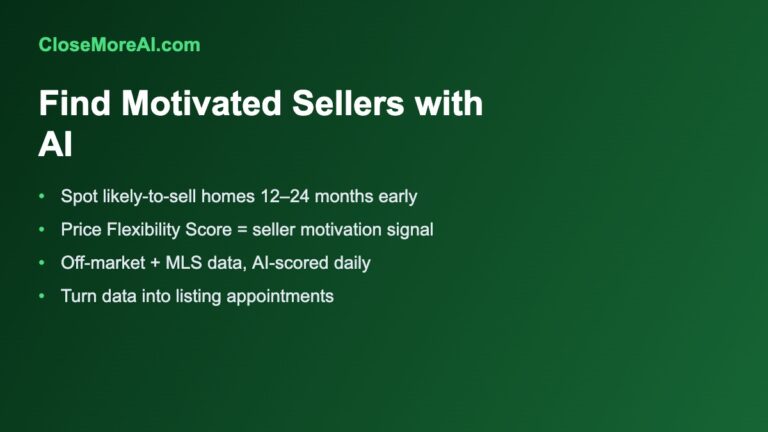
AI improves every stage of this pipeline. First, monitoring: platforms ingest default filings continuously instead of monthly. Second, prediction: property-intelligence tools score financial-distress signals — equity position, loan vintage, tax delinquency, ownership tenure — across tens of millions of properties, so you can flag likely defaults in your farm area before the notice hits the public record. Third, prioritization: among active pre-foreclosures, AI ranks who has sellable equity and realistic timelines, so you call the ten owners you can actually help. Compare the platforms that do this in our roundup of the best AI lead generation tools for real estate.
The 5-step AI workflow for pre-foreclosure leads
- Set your territory and equity floor. Focus on ZIP codes you know and owners with enough equity for a clean sale — those are the files where listing beats auction.
- Combine public notices with AI scoring. Pull active NOD/lis pendens filings, then let the AI rank them by equity and sell-probability — see how AI predicts when homeowners will sell.
- Watch the pre-default signals. Tax delinquency plus long tenure plus high equity is a classic pattern; reaching an owner before the filing is both kinder and less competitive.
- Tag by timeline in your CRM. Days-to-auction drives everything: a file 30 days out needs a different conversation than one 150 days out.
- Re-rank weekly. This niche moves fast — reinstatements, postponements, and new filings change the list every week.
Whichever platform you choose, the workflow matters more than the brand: continuous monitoring of new filings, equity-aware ranking, and a weekly re-rank are what actually win these listings.
Outreach that helps instead of hounds
Distressed owners are buried in predatory mail. Stand out by being the opposite: lead with options, not urgency theater. An effective first letter covers three things in plain language — what the notice means, the owner’s full menu (reinstate, modify, sell, or counsel with a HUD-approved agency), and a specific net-proceeds estimate if they sold at market price. Follow up by phone within a week, honoring Do-Not-Call rules, and keep a quarterly touch on files that reinstate — many re-default within a year. Pre-foreclosure work pairs naturally with the rest of a listing-side pipeline: run it alongside AI motivated-seller detection and your absentee owner list, since non-occupant owners default at higher rates.
Where pre-foreclosure data actually comes from
AI ranks the list, but the underlying records are public and you can verify every one. Knowing the source keeps you honest with owners, and it lets you cross-check a tool’s data before you spend a stamp or a call on it.
| Signal | Where it’s filed | How to pull it |
|---|---|---|
| Notice of Default (NOD) / lis pendens | County recorder or clerk of court (non-judicial vs. judicial states) | Recorder’s online index, or the county’s public foreclosure / lis-pendens docket |
| Notice of Trustee/Sheriff Sale + auction date | County recorder, sheriff’s office, or the legal-notices section of the local paper | Sheriff-sale listings and statutory legal-notice publications |
| Property-tax delinquency (early distress) | County treasurer / tax collector | Delinquent-tax roll, usually searchable by parcel |
| Ownership, mortgage & lien history | County recorder (deeds, mortgages, releases) | Deed index — note the original loan amount and date to estimate equity |
| Assessed value & homestead status | County assessor | Assessor parcel search; a rough equity check against the recorded loan |
| Owner options & counseling | HUD-approved housing counseling agencies | HUD counselor finder — cite it in your outreach |
An AI tool earns its keep by aggregating these feeds daily and scoring equity and sell-probability, but the records themselves are free to confirm. If a platform’s coverage is thin in the counties you farm, the public index is your fallback.
Outreach scripts you can copy
Distressed owners are drowning in urgency-theater mail from investors. Win by sounding like the calm professional who explains options. Adapt these to your voice and, critically, to your state’s disclosure rules (see below).
First letter (options-first):
Dear [Owner name],
Public records show a default notice was recently filed on [property address]. I’m a licensed real estate agent in [area], and I’m writing for one reason: while that notice is active, you still have choices — and most of them beat an auction.
Depending on your situation you may be able to reinstate the loan, work out a modification with your servicer, speak with a HUD-approved housing counselor at no cost, or sell before the sale date and keep your remaining equity. If a sale makes sense, I can give you a realistic net-proceeds estimate for [property address] with no obligation.
No pressure and no fee for a conversation. If it would help to understand your options, call or text me at [phone].
— [Name], [Brokerage], License #[number]
Voicemail (under 20 seconds):
“Hi [Owner name], this is [Name], a local licensed agent. I sent you a note about the filing on [street]. I’m not selling anything — I just wanted you to know you still have options, including selling before the sale date and keeping your equity. If it’s useful, call or text me back at [phone]. Take care.”
Follow-up email:
Subject: Your options on [street] — a quick, no-pressure summary
Hi [Owner name], following up on my letter. Here’s the short version of what owners in your position can usually do: (1) reinstate by catching up what’s owed, (2) ask your servicer about a modification, (3) talk to a free HUD-approved counselor, or (4) sell before the sale date. If selling is on the table, I’ll prepare a net-proceeds estimate for [property address] so you can compare it against the other paths. Reply here or call/text [phone] — and if you’d rather I stop reaching out, just say so and I will.
— [Name], [Brokerage]
Compliance: the rules for this niche
Pre-foreclosure outreach carries more legal weight than ordinary prospecting. None of this is legal advice — confirm specifics with your broker and your state’s statute — but these are the guardrails every agent should work inside:
- Foreclosure-consultant / equity-purchase laws. Many states (California’s Civil Code §2945 is the best-known example) regulate anyone who solicits a homeowner already in default. They often require specific written disclosures, a right to cancel, and — importantly — ban collecting any upfront fee for foreclosure-related help. Know your state’s version before you mail.
- TCPA (calls & texts). Get prior express consent before autodialed or pre-recorded calls or texts, keep to allowed calling hours, and honor opt-outs immediately. A public record is not consent to be auto-texted.
- Do-Not-Call. Scrub numbers against the federal DNC registry (and your state’s list) and keep your own internal do-not-call list.
- CAN-SPAM (email). Use a truthful subject line, identify yourself, include a physical mailing address, and provide a working unsubscribe.
- Fair housing & honesty. No targeting or messaging that references protected classes, and never imply you’re affiliated with the lender, a government agency, or a “foreclosure rescue” program.
FAQs
Are pre-foreclosure leads legal to market to?
Yes — default notices are public records. But this niche has extra rules: several states regulate foreclosure-rescue solicitations and require specific disclosures, so know your state’s statute and never charge upfront fees for foreclosure-related help.
How is a pre-foreclosure sale different from a short sale?
If the owner has equity, it’s a normal (if time-boxed) listing. A short sale only enters the picture when the debt exceeds the value and the lender must approve a below-payoff price — a longer, lender-driven process.
What’s the best AI tool for pre-foreclosure leads?
The best tool does two things well in your market: it predicts financial distress before the public filing, and it ranks active files by sellable equity so you spend your time on owners you can genuinely help. Several property-intelligence platforms do this — compare them side by side in our roundup of the best AI lead generation tools for real estate, and match the data coverage to the counties you actually farm.
Where do agents find pre-foreclosure filings?
They’re public records. Notices of Default and lis pendens are recorded at the county recorder or clerk of court; trustee and sheriff-sale notices appear there and in local legal-notice publications; and early distress often shows first as property-tax delinquency at the county treasurer. AI tools simply aggregate and score these feeds daily so you don’t have to check each county by hand.
How soon after a Notice of Default should I reach out?
Quickly, but with substance. The equity that makes a listing possible erodes every week in fees and interest, and the owner’s options narrow as the sale date approaches. Reaching out within days — with a clear explanation of choices rather than pressure — is both kinder and less competitive than waiting until investors have papered the mailbox.
Bottom line
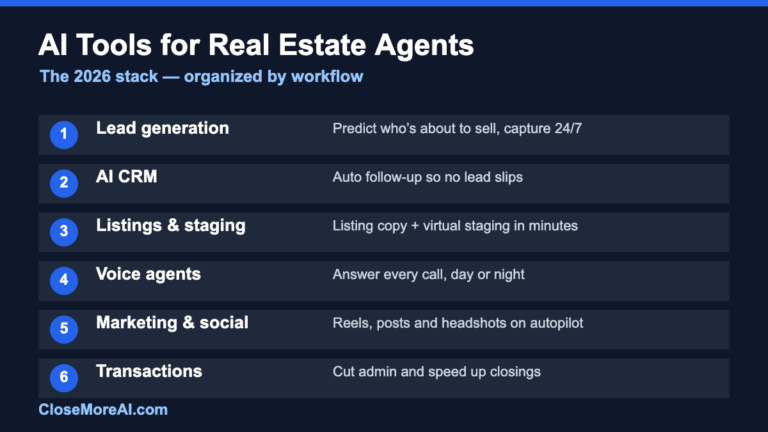
Pre-foreclosure leads are where speed, data, and decency compound: AI finds the owners early, ranks who you can genuinely help, and leaves you to do the human part — showing a stressed homeowner that a dignified exit exists. Build the weekly workflow, respect the rules, and see how it fits your stack in our complete guide to AI tools for real estate agents. And grab the free 2026 AI Toolkit for Real Estate Agents — 25 tools that win listings and close deals, in one shortlist.
Related guides
- How to find tax-delinquent property leads with AI — the distress signal that usually shows up before pre-foreclosure.
- How to find vacant property leads with AI — vacancy often follows financial distress.