How to Find Vacant & Abandoned Property Leads With AI in 2026: The Agent’s Playbook
Vacant and abandoned property leads are one of the quietest listing sources in real estate — and one of the least contested. An empty house is a carrying cost with no one living in the value: taxes, insurance, and upkeep keep draining the owner while the property sits idle. Many of these owners are out of the area, holding an inherited home, or simply worn out by a property that has become a burden. That combination — a non-performing asset, an absent or tired owner, and mounting costs — is exactly what makes a rational, motivated seller. This playbook shows you how to build a vacant-property pipeline with AI in five steps.
Updated September 2026.
In this guide:
- Why vacant-property leads convert so well
- How vacant differs from absentee and pre-foreclosure
- The signals that flag a motivated vacant-home owner
- Where to find vacant-property data (by signal)
- How AI finds and ranks vacant-property owners
- The 5-step AI workflow
- Outreach that actually gets replies
- Outreach scripts you can copy
- Compliance: TCPA, DNC & CAN-SPAM
- Mistakes to avoid
- FAQs
Why vacant-property leads convert so well
Empty homes are a bigger pool than most agents assume. ATTOM’s Q2 2026 Vacant Property and Zombie Foreclosure Report found that nearly 1.4 million residential properties — about 1.3% of all homes — sat vacant across the United States (ATTOM Q2 2026 report). Behind each of those addresses is an owner paying to hold an asset that produces nothing.
For a listing agent, that idle cost is the opening. An owner carrying an empty house they no longer want is usually far more receptive to a clean, no-hassle sale than a homeowner living happily in place. They respond to net-proceeds math instead of neighborhood nostalgia, they rarely have an existing agent relationship, and the monthly bleed of taxes and insurance is a deadline of its own. The hard part has never been that vacant homes don’t exist — it’s finding the ones whose owners are ready to sell rather than the ones who are mid-renovation or between tenants. That is exactly what AI solves.
How vacant differs from absentee and pre-foreclosure
These categories overlap, but they are not the same list — and treating them identically is why most agents work them poorly. An absentee owner lives somewhere other than the property, but the home itself may be a fully rented, cash-flowing investment. A pre-foreclosure is driven by mortgage default, where the owner’s equity is often already thin. A vacant property is defined by the house standing empty — regardless of whether there’s a mortgage, a tenant history, or a distress event behind it. Vacancy frequently signals an owner who has already emotionally checked out: an inherited home no heir wants to manage, a tired rental between tenants, or a second property that became a liability.
Work each angle with different messaging. Vacancy often stacks on top of other distress — an empty home can also be an inherited probate property or a parcel that is tax-delinquent at the same time. Cross-referencing those lists catches the most motivated owners earlier.
The signals that flag a motivated vacant-home owner
Not every empty house is a listing — plenty are simply mid-renovation or seasonally used. AI helps you rank the ones most likely to transact by stacking signals:
- USPS-confirmed vacancy — mail flagged as undeliverable-vacant is the single strongest public indicator a home is genuinely empty.
- Owner mailing address far from the property — an out-of-area owner managing an empty house from a distance is a classic tipping point.
- Deferred maintenance or code complaints — overgrown lots, utility shut-offs, or municipal code violations signal an owner who has stopped reinvesting.
- Long ownership tenure with high equity — decades of appreciation plus carrying costs the owner no longer wants to shoulder.
- Recent inheritance or estate transfer — heirs frequently end up with a house they never planned to keep.
- Overlapping distress — tax delinquency, a lien, or pre-foreclosure layered on top of vacancy sharpens the motivation.
Any one of these is a maybe. Stacked together, they describe a listing waiting to happen — and that stacking is precisely what a scoring model does well.
Where to find vacant-property data (by signal)
AI ranks the list, but the raw signals come from public and commercial records you can pull yourself. Here is where each signal actually lives — so you can verify what a platform surfaces, or build a starter list by hand before you subscribe to anything.
| Signal | Where to find it | What to watch for |
|---|---|---|
| Confirmed vacancy | USPS Vacant Indicator, accessed through a licensed data provider or your CRM’s list-builder (USPS does not sell it directly to agents) | Flagged when a carrier reports mail undeliverable-vacant for 90+ days — the strongest public vacancy signal. |
| Owner & mailing address | County assessor / property appraiser records, usually free and searchable online | Compare the owner’s mailing address to the property address to flag out-of-area owners. |
| Code violations & nuisance | City or county code-enforcement and “open data” portals; building-department complaint logs | Overgrown lots, board-ups, and unresolved citations point to an owner who has stopped reinvesting. |
| Equity & tenure | Recorder of deeds (purchase price, mortgage and lien records) plus the assessor (assessed value) | Long tenure with a small or paid-off mortgage means room to sell at a clean number. |
| Inheritance / estate transfer | Probate court filings and recent deed transfers into an estate or to an heir | Heirs often end up with a house they never planned to keep. |
| Overlapping distress | County treasurer or tax-collector (delinquency) and the clerk’s lis pendens / pre-foreclosure filings | Cross-reference to catch the most motivated owners first. |
A predictive platform like Homesage AI pulls most of these feeds together and scores them for you; the table above is what it draws from under the hood, and a useful checklist if you want to sanity-check a list before you work it.
How AI finds and ranks vacant-property owners
The old way was pulling a county list, driving for dollars, and mailing every boarded-up house the same postcard. AI platforms now do that plus the part that matters: ranking. Predictive tools like Homesage AI analyze more than 150 million U.S. properties and layer ownership, equity, tenure, occupancy, and life-event signals on top to score how likely each owner is to sell in the next 6–12 months. Instead of mailing 1,500 empty parcels, you work the 40 owners most likely to actually transact. Book a free Homesage demo to see the ranked list for your farm area, or read our full Homesage AI review first.
This is the same predictive engine we cover in our guide on how AI predicts when homeowners will sell — pointed specifically at owners sitting on empty homes.
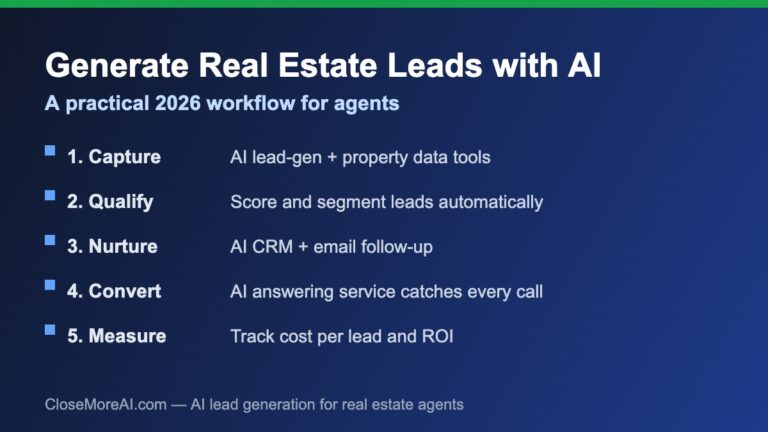
The 5-step AI workflow for vacant-property leads
- Pull vacancy and ownership data. Start with USPS-vacant flags, county assessor records, and code-enforcement lists for your target ZIP codes — the same area you’d choose for AI-powered farming.
- Filter for equity and owner type. Isolate higher-equity, low-mortgage properties and flag owners whose mailing address differs from the property address.
- Let the AI rank by sell-probability. This is the step that separates AI from a list broker: score owners by vacancy confirmation, equity, tenure, and overlapping distress rather than treating every empty house equally.
- Layer your CRM. Push the top 40–80 into your CRM with tags (confirmed-vacant, out-of-area, inherited, high-equity) so every message speaks to that owner’s specific situation.
- Work the list monthly. Occupancy and scores refresh — a home that reads as seasonally empty in spring can flip to a genuine sell signal as carrying costs mount.
See the ranked seller list for your farm area — free Homesage AI demo →
Outreach that actually gets replies
Owners of vacant homes respond to relief and to math — not to “I’d love to list your home.” Lead with the exit: an estimate of current value, a realistic sell-vs-hold comparison, and what net proceeds look like after clearing any back costs and selling expenses. Acknowledge the burden directly but respectfully: “If keeping the house on Maple Street has become more hassle than it’s worth, you may have more equity to work with than you think.” A three-touch sequence works well — a short letter with a specific valuation, a follow-up call two weeks later, and a quarterly check-in for owners who aren’t ready yet.
Because most listings go to the first credible agent a seller speaks with (NAR research & statistics), simply being the trusted agent in the mailbox when an owner finally decides to offload an empty house is often the whole game. Pair this list with AI motivated-seller detection and the timing takes care of itself.
Outreach scripts you can copy
Adapt these to your voice and your market, and always drop in real specifics — the street name, a genuine value range, and your license details. Lead with relief and net proceeds, never “I’d love to list your home.”
Letter or postcard
“Hi [Owner name] — I work with owners of empty homes here in [neighborhood], and I noticed the house at [property address] looks like it may be sitting unused. If holding it has become more hassle than it’s worth, I can put together a no-obligation estimate of what it would sell for today and what you’d net after costs. No pressure either way — just reply, call, or text [phone] and I’ll send it over. — [Name], [Brokerage], License #[number]”
Voicemail
“Hi [Owner name], this is [Name] with [Brokerage] here in [city]. I help owners of vacant homes weigh whether to sell or keep holding, and I’d be glad to send you a quick, no-obligation value estimate on [street name] — nothing owed, nothing to sign. My number is [phone]. Thanks, and have a good one.”
Subject: Quick question about [street name]
Hi [Owner name],
I work with owners of empty homes in [area] and wanted to reach out about [property address]. If keeping it has started to feel like more cost than it’s worth, I can send a free estimate of today’s value and your likely net proceeds — no obligation and no cost.
Would that be useful? Just reply and I’ll put it together.
[Name], [Brokerage] · [Phone] · License #[number]
Reply STOP or let me know and I won’t email again.
Space these into a three-touch sequence — letter first, a call about two weeks later, then a quarterly check-in for owners who aren’t ready yet.
Compliance: TCPA, DNC & CAN-SPAM
Vacancy, assessor, and code data are public or commercially licensed, so building the list is legal. How you contact owners is where the rules bite. This is general information, not legal advice — verify against current federal and state rules and your broker’s policy before you launch a campaign.
- Calls & texts (TCPA + DNC). Scrub numbers against the National Do-Not-Call Registry and honor internal opt-outs. The TCPA restricts autodialed and pre-recorded calls and texts to cell phones without prior express consent — for cold prospecting, call and text manually rather than through an autodialer, and keep records of consent and opt-outs.
- Email (CAN-SPAM). Use a truthful subject line and “from” name, identify the message as outreach, include a valid physical mailing address, and provide a working opt-out that you honor promptly.
- State rules. Several states add their own layers — Florida’s “mini-TCPA,” for example, tightens consent for calls and texts, and states such as California and Oklahoma have their own restrictions. Check the rules for every state you farm.
- Direct mail is the lowest-risk channel for cold vacant-owner outreach, which is why the letter above leads the sequence.
Mistakes to avoid
- Treating it like an absentee list. A vacant home and a rented out-of-state investment are different situations — the equity profile and the right message differ. See our absentee-owner playbook to work that angle separately.
- Mailing every empty house equally. Volume without ranking is the old game — and it’s why most campaigns die of postage costs before the first listing.
- Assuming vacant means distressed. Plenty of empty homes are mid-renovation or seasonally used. Confirm the vacancy and the owner’s motivation before you invest touches.
- Ignoring the overlap with other lists. Vacant owners are often also heirs on a probate property or behind on property taxes — cross-reference to reach them first.
- One-and-done outreach. These owners sell on their own timeline; the agent still following up when the carrying cost finally bites wins the listing.
FAQs
What is a vacant property lead?
It’s a home that is standing empty — whether inherited, between tenants, or simply held and neglected. Because a vacant house generates carrying costs (taxes, insurance, upkeep) with no offsetting use, its owner is often more motivated than average to sell, which makes these addresses a high-intent listing source.
How is a vacant property different from an absentee owner?
Absentee simply means the owner lives elsewhere — the property could be a fully rented investment. Vacant means the house itself is empty. The two frequently overlap, but a confirmed-vacant home usually signals stronger motivation because the owner is paying to hold an asset that produces nothing.
Is vacancy data legal to market to?
Yes — USPS vacancy indicators, assessor records, and code-enforcement lists are public or commercially available data. Follow standard rules: honor Do-Not-Call for phone outreach, include an opt-out in every email, and keep messaging discreet and respectful.
What’s the best AI tool for finding vacant-property leads?
For seller-side prediction we recommend Homesage AI — it ranks owners by likelihood to sell rather than just listing every empty parcel. Compare alternatives in our guide to the best AI lead generation tools for real estate.
How do I confirm a property is actually vacant before I spend touches on it?
Stack a USPS vacancy flag with a quick check for the tell-tale signs of an empty home — no utility activity, an overgrown lot, accumulated mail or notices, or a code-enforcement complaint on file. A single drive-by or a look at recent street-level imagery confirms most cases. Confirming vacancy first is what keeps you from mailing homes that are simply mid-renovation or seasonally used.
Can I call or text vacant-property owners?
You can, but scrub every number against the National Do-Not-Call Registry first, honor any opt-out immediately, and avoid autodialers or pre-recorded messages for cold outreach — the TCPA restricts those to cell phones without prior consent. Direct mail is the lowest-risk opener, which is why it usually leads the sequence. This is general guidance, not legal advice.
Bottom line
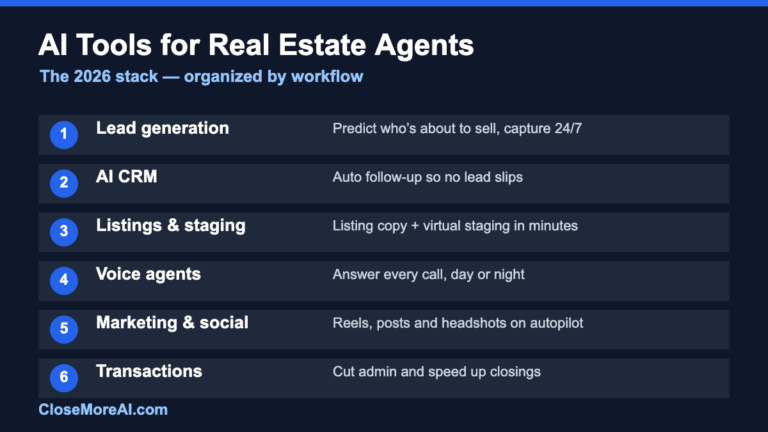
Vacant and abandoned property leads are a listing source most agents skip — partly because they lump it in with absentee or pre-foreclosure, and partly because working a raw county list by hand is miserable. AI removes both problems: it confirms genuine vacancy, separates it from mere absenteeism, and ranks the owners most likely to sell so you spend your time on conversations instead of spreadsheets. Start with the ranked list, work it monthly with discreet, options-focused outreach, and see how it fits the rest of your stack in our complete guide to AI tools for real estate agents. And grab the free 2026 AI Toolkit for Real Estate Agents — 25 tools that win listings and close deals, in one shortlist.