Best AI Lead Generation Tools for Real Estate Agents (2026)
Updated October 2026: we re-checked every tool’s positioning and re-verified pricing on each vendor’s official page this month. The short version on cost: only Real Geeks publishes a public rate card — everything else here is quote-based and depends on your territory, seat count, or lead volume. Prices change, so confirm the current number on the vendor’s own page before you sign.
Table of Contents
- What AI changed about lead gen
- What to look for in 2026
- Predictive seller-intent platforms
- Capture + CRM platforms for buyer leads
- Quick comparison
- How much do they cost?
- How to choose
- Mistakes that waste the spend
- FAQ
- Bottom line
Every agent’s business lives or dies by one thing: a steady flow of people who actually want to buy or sell. The problem usually isn’t a shortage of leads — it’s that most leads are cold, mistimed, or never followed up. That’s where the newest AI lead generation tools for real estate come in: instead of just collecting names, they try to predict who’s likely to transact, surface seller intent early, and start the conversation for you. This guide compares the main options agents are actually using in 2026, what each one is genuinely good at, who should skip it, and roughly what they cost. There is no single “best” tool here — the right pick depends entirely on which part of your pipeline is leaking.
What AI actually changed about lead generation
Traditional lead gen meant buying a list or running ads and hoping. The newer AI lead generation tools work differently: they analyze large property and behavioral datasets to flag homeowners showing pre-listing signals, score inbound leads by how ready they are, and automate the first touches so no lead sits cold. In practice that shifts your day from chasing everyone to working a shorter, ranked list of people closer to a decision. The three things AI does that a spreadsheet never could: predict timing (who is statistically more likely to move in the next 6–12 months), prioritize (which of today’s inbound leads to call first), and respond instantly (a text or email goes out in seconds, while the lead is still warm).
One honest caveat up front: a “predicted seller” is a probability, not an appointment. These models narrow a huge market down to a workable list — they do not hand you people who have already decided to sell. Every tool below still assumes you (or an ISA) will do the outreach.
What to look for in 2026
Before you commit to a platform, check four things. Predictive intent — does it tell you who to contact now, not just hand you a pile of names? Data quality — how deep and current is the property and contact data behind its predictions, and does it keep phone and email records updated? Automation — can it run the first follow-ups (text, email) without you babysitting it, or does it just deliver a list? And integration — does it sync cleanly with your CRM so captured leads don’t fall through the cracks? Weight predictive accuracy and follow-up automation most heavily; those are where AI earns its keep. A tool that predicts a seller but never nudges them is only doing half the job — and a contract you can’t exit is a bigger risk than a monthly fee you can.
Predictive seller-intent platforms
These tools try to find likely sellers before they list, by reading property, equity, and life-event data. They’re the right category if your biggest leak is missing listings to a competitor who got there first. Pricing across this whole group is quote-based and usually tied to a territory or lead volume.
SmartZip — predictive geographic farming
What it does: SmartZip pioneered predictive analytics for real estate. It scores homeowners in a farm area by likelihood to sell in roughly the next 12 months, then wraps that data in automated direct-mail and digital-ad campaigns, with a companion CheckIn app that hands you a daily action list (smartzip.com).
Best for: listing agents who already commit to a defined ZIP code or neighborhood and will work it for a year or more.
Who should skip it: agents who want month-to-month flexibility or won’t touch the farm consistently — it’s a premium, territory-based commitment, and the data only pays off with repetition.
Offrs — territory lead feed with a volume guarantee
What it does: Offrs scores homeowners across 250+ data points and markets that it predicts a large share of listings in a territory. Its Lead Feed product guarantees a minimum number of leads per month by subscription tier and will expand your territory automatically if it falls short (offrs.com).
Best for: agents who want a steady, guaranteed daily feed of seller-intent leads and have a follow-up system ready to absorb them.
Who should skip it: anyone who can’t work a daily feed — a guaranteed volume you never call is just a bigger bill.
Catalyze AI — life-event and inherited-property signals
What it does: Catalyze AI leans on life-event and behavioral data to flag owners with a higher probability of selling — particularly inherited and probate properties, a niche most agents never systematically work (catalyzeai.com).
Best for: agents who want a second, differentiated seller feed focused on life-event sellers rather than broad geographic scoring.
Who should skip it: agents who want wide market coverage, or who aren’t comfortable with the sensitivity of probate and inheritance outreach. Treat these as warm signals that need careful, respectful nurturing.
Likely.ai — prediction plus database enrichment
What it does: Likely.ai predicts likely sellers and, just as usefully, keeps a database current — appending and correcting phone numbers and emails so your existing sphere and farm data don’t rot. Its pitch is as much “clean and enrich what you already have” as “find new names.”
Best for: agents and teams sitting on a large, stale database who want it scored and re-verified before they prospect it.
Who should skip it: brand-new agents with no database yet — there’s little to enrich, so you’d be paying mostly for the prediction layer alone.
Homesage.ai — prediction with follow-up built in
What it does: Homesage.ai surfaces homeowners showing pre-listing signals and layers AI-driven follow-up on top, so the first outreach can run without you starting each conversation manually. It bills in credits rather than per seat.
Best for: solo agents and small teams who want the prediction and the first follow-ups in one place rather than stitching a list to a separate CRM.
Who should skip it: agents who already run a CRM they like and just want a raw data feed, or anyone who won’t work the list daily — built-in automation still needs a human to take the booked conversations.
Capture + CRM platforms for buyer leads from ads
If your model is running Google and Meta ads and converting the clicks, you need a different category: an IDX home-search site that captures the lead, plus an AI-assisted CRM that scores and auto-responds so speed-to-lead stays tight. These are platform + ad-spend commitments, and the AI only shines if you feed it consistent traffic.
Lofty (formerly Chime) — all-in-one with heavy automation
What it does: Lofty combines IDX sites, a CRM, an AI assistant, dialer, and ad tools in one platform, with tiers for solo agents, teams, brokers, and enterprise.
Pricing: quote-based. Lofty’s own pricing page lists four tiers but shows a “Request Pricing” button rather than dollar amounts, and notes cost “varies based on your choice of platform package, seat count, optional upgrades and lead-gen programs” (lofty.com/pricing).
Best for: teams that want one system for capture, nurture, and dialing and will feed it steady ad traffic.
Who should skip it: solo agents who want something simple and cheap, or anyone not running consistent ad spend to fill the funnel.
CINC — team-scale lead gen and CRM
What it does: CINC is an all-in-one platform (IDX, CRM, automation, dialer, video and text) built around managed Google and Facebook ad campaigns — it says it manages over $30M in annual ad spend on behalf of clients. Tiers run Solo, Ramp, Pro, and Select by user count (cincpro.com).
Pricing: quote-based — no public rate card; you request a demo for a number.
Best for: established teams with real ad budgets that want lead gen and follow-up managed in one place.
Who should skip it: solo or budget-conscious agents — this is a team-scale commitment, not a starter tool.
Real Geeks — the one with a published price
What it does: Real Geeks is an IDX + CRM platform with optional AI tools and bolt-on lead packages. It’s the only tool in this guide that publishes its pricing openly.
Pricing (from Real Geeks’ official page, verified October 2026): the core platform is $399/month plus a one-time $500 setup fee and includes 2 users and 60+ tools. Optional add-ons: Social lead packages $299/month, Search or Seller lead packages $599/month, Geek AI Text $49/month (free with any lead package), IDX feeds $10/month per MLS board, and additional users from $25/month (realgeeks.com/pricing).
Best for: agents and small teams who want a transparent, predictable monthly cost and the option to add lead flow when they’re ready.
Who should skip it: agents who specifically need predictive seller data — Real Geeks captures and nurtures demand, it doesn’t forecast who’s about to list.
Quick comparison
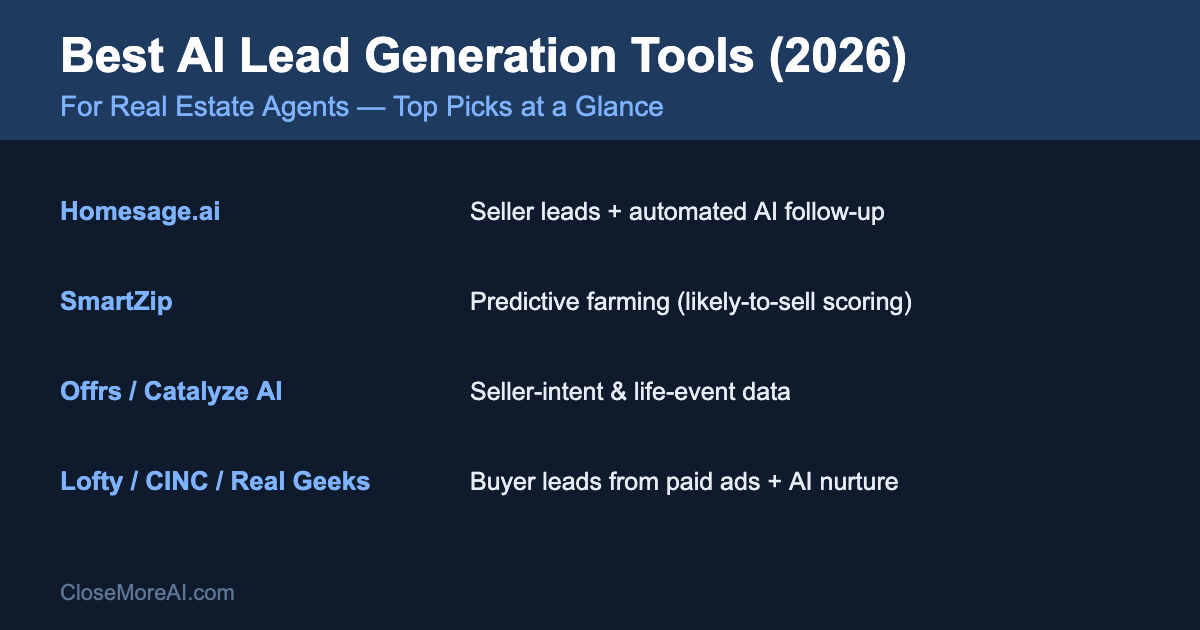
| Tool | Category | Best for | Pricing (Oct 2026) |
|---|---|---|---|
| SmartZip | Predictive farming | Committed geographic farmers | Quote-based, territory |
| Offrs | Predictive seller feed | Agents wanting a guaranteed daily feed | Quote-based, by tier |
| Catalyze AI | Life-event / probate signals | A differentiated second feed | Quote-based |
| Likely.ai | Prediction + enrichment | Cleaning a large existing database | Quote-based |
| Homesage.ai | Prediction + follow-up | Solos wanting data + outreach in one | Quote-based, credits |
| Lofty | Capture + CRM | Teams running ad traffic | Quote-based, by seat |
| CINC | Capture + CRM | Established teams with ad budget | Quote-based, by seat |
| Real Geeks | Capture + CRM | Agents wanting transparent cost | $399/mo + $500 setup |
How much do AI lead generation tools cost?
Here’s the honest picture: most of these vendors don’t publish prices. When we checked each official page in October 2026, only Real Geeks listed real numbers; SmartZip, Offrs, Catalyze AI, Likely.ai, Lofty, CINC, and Homesage.ai all route you to a demo or “request pricing” form. That makes direct comparison hard, so it helps to know the three cost shapes you’ll run into:
Predictive seller platforms (SmartZip, Offrs, Catalyze AI, Likely.ai, Homesage.ai) are usually a recurring subscription tied to a territory or lead volume — plan for a meaningful monthly commitment, often with a term, because the data and automation are the product. Capture-plus-CRM platforms (Lofty, CINC, Real Geeks) combine a monthly software fee with your own ad spend on top — the software is only half the real cost. Transparent rate cards are rare: Real Geeks’ $399/month base is the clearest published example, which is itself a reason some agents start there.
Whatever the sticker price, judge it against a single commission. In most US markets, one extra closed deal a year covers a year of almost any of these tools several times over. The expensive tool is the one you pay for and never work — and the risky one is the annual contract you can’t exit if it underperforms. Ask every vendor two questions before signing: what’s the real monthly total including ad spend, and what’s the exit clause?
📥 Free: the 2026 AI Toolkit for Real Estate Agents. 25 hand-picked tools organized by workflow — lead gen, listings, follow-up, closing — plus the prompts and the per-lead cost math we use to compare them. Enter your email and we’ll send the PDF over:
No spam, ever. Unsubscribe anytime.
How to choose without overthinking it
Match the tool to your bottleneck, not to a leaderboard. If you need sellers and work a defined area, start with predictive farming (SmartZip). If you want a guaranteed seller-intent feed, look at Offrs; if you want a differentiated life-event niche, Catalyze AI; if you’re sitting on a big stale database, Likely.ai; and if you want prediction with the first follow-ups attached, Homesage.ai. If you live on buyer leads from ads, an IDX capture-plus-CRM platform keeps speed-to-lead tight — Lofty or CINC at team scale, Real Geeks when you want a transparent, lower-commitment starting point. Whatever you choose, the tool only pays off if you follow up fast: pair it with one of the best AI answering services so no lead ever hits voicemail, and make sure it syncs with your CRM — see our roundup of the best AI CRMs for real estate agents. According to the National Association of Realtors, speed and consistency of follow-up remain among the biggest differentiators between agents who convert leads and those who don’t.
Mistakes that waste the spend
The tool rarely fails on its own — the process around it does. The four that burn money most often: buying prediction you won’t work (a daily seller list is worthless if you don’t call it); signing an annual contract before a trial (always ask for a shorter term or an exit clause first); paying for capture without ad budget (an IDX site with no traffic captures nothing); and letting leads skip the CRM (if a predicted seller or captured buyer never lands in a system that reminds you to follow up, you’ve paid for a name and lost it). Fix the follow-up habit first; the tool amplifies whatever system you already have, good or bad.
Frequently asked questions
What is the best AI lead generation tool for real estate agents?
There isn’t a single best one — it depends on your bottleneck. If you need to find sellers early in a farm, a predictive platform like SmartZip or Offrs fits; if you want prediction with follow-up attached, Homesage.ai; if you convert paid ads, a capture-plus-CRM platform like Lofty, CINC, or Real Geeks fits better. Pick the category that matches your leak before you compare individual tools.
Do AI real estate lead generation tools actually work?
They generate opportunities, not closings. Predictive tools reliably narrow a huge market down to the homeowners statistically most likely to transact, which makes prospecting more efficient. The results still depend on you (or an ISA) working the list quickly and consistently; the AI shortens the odds, it doesn’t remove the work.
How much do AI real estate lead tools cost?
Most are quote-based. As of October 2026, Real Geeks is the main one publishing prices ($399/month base plus a $500 setup fee, with optional lead packages from $299–$599/month). Predictive seller platforms and other capture-plus-CRM tools route you to a demo for a number and usually tie cost to territory, seats, or lead volume — and capture platforms add your own ad spend on top.
Can AI find sellers before they list?
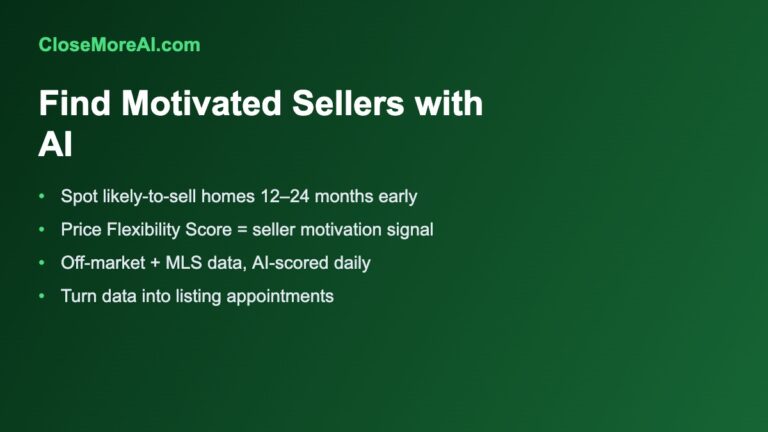
That’s what seller-intent AI is built to attempt: by reading property, equity, and life-event signals, tools like SmartZip, Offrs, Catalyze AI, Likely.ai, and Homesage.ai surface owners who show pre-listing behavior, giving you a window to reach them early. Treat the output as a ranked probability list, not a set of confirmed sellers. See our guide on predicting when homeowners will sell.
Bottom line
The best AI lead generation tools for real estate don’t just hand you more names — they tell you who to contact today and, in some cases, start the conversation for you. But there is no universal winner: predictive platforms (SmartZip, Offrs, Catalyze AI, Likely.ai, Homesage.ai) earn their keep when your leak is finding sellers early, while capture-plus-CRM platforms (Lofty, CINC, Real Geeks) earn theirs when your leak is converting ad traffic. Real Geeks is the easiest to price-check because it publishes its rates; the rest require a demo. Pick the category that fixes your biggest leak first, confirm the current price and exit terms on the vendor’s own page, and then actually work it.
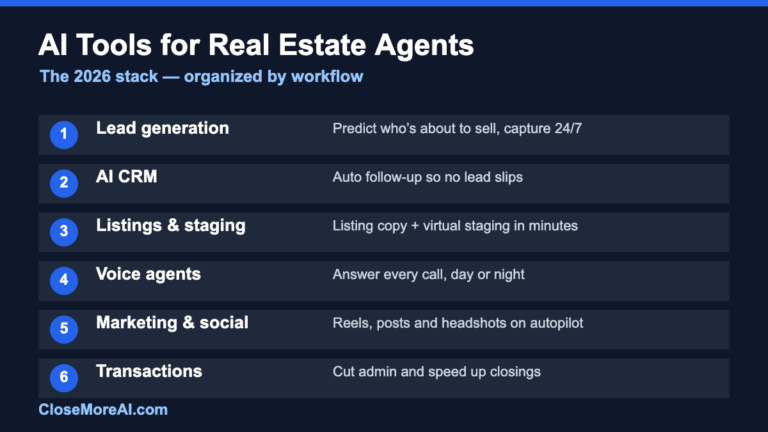
Lead gen is the top of the funnel — see how it fits the whole stack in our complete guide to the best AI tools for real estate agents, then grab the free 2026 AI Toolkit for Real Estate Agents for the full shortlist in one place.
Related guides
- How to use AI to predict when homeowners will sell — what the prediction layer actually does.
- How to find motivated sellers with AI — the signals that matter and how to read them.
- How to find absentee owner leads with AI — a warm, under-worked pool these tools handle well.
- AI real estate farming in 2026 — how to point predictive tools at a geographic farm.
- How to find vacant property leads with AI — a step-by-step play for one specific lead type.